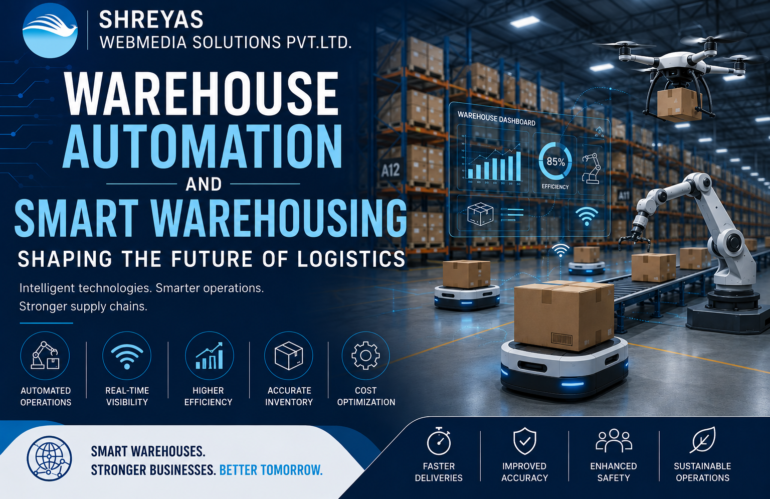
How Automation, AI, and Robotics Are Reshaping Global Supply Chains
In an era defined by rapid e-commerce growth, rising customer expectations, and increasingly complex supply chains, traditional warehousing models are struggling to keep pace. Businesses today are expected to deliver products faster, manage inventory more accurately, and maintain operational efficiency while controlling costs. To meet these demands, organizations are turning to smart warehousing and automated fulfillment solutions that are revolutionizing the logistics industry.
Powered by technologies such as Artificial Intelligence (AI), the Internet of Things (IoT), robotics, and machine learning, smart warehousing is transforming how goods are stored, tracked, picked, packed, and shipped. As automation becomes a cornerstone of modern supply chains, the future of warehousing is set to become more intelligent, agile, and customer-centric than ever before.
Understanding Smart Warehousing
Smart warehousing refers to the use of advanced digital technologies and automation systems to optimize warehouse operations. Unlike traditional warehouses that rely heavily on manual labor and paper-based processes, smart warehouses leverage real-time data, connected devices, and intelligent software to improve efficiency and accuracy.
The evolution toward smart warehousing has been largely driven by the rise of e-commerce and the growing need for faster order fulfillment. Consumers now expect same-day or next-day deliveries, making speed and precision critical factors for business success.
Through automated inventory tracking, predictive analytics, and robotics, smart warehouses can streamline workflows, reduce errors, and maximize storage capacity. The result is a more responsive and scalable logistics environment capable of adapting to changing market demands.
The Growing Role of Automation in Warehousing
Automation is at the heart of the smart warehousing revolution. From robotic picking systems to autonomous vehicles, modern warehouses are increasingly relying on technology to perform repetitive and labor-intensive tasks.
Automated Guided Vehicles (AGVs) and Autonomous Mobile Robots (AMRs) can transport goods across warehouse floors without human intervention. These systems help reduce operational bottlenecks, improve workplace safety, and increase productivity.
Meanwhile, AI-powered warehouse management systems analyze vast amounts of operational data to optimize inventory placement, workforce allocation, and order processing. Machine learning algorithms continuously learn from warehouse activities, helping businesses improve decision-making and operational efficiency over time.
By automating routine processes, organizations can significantly reduce labor costs while improving speed, consistency, and accuracy throughout the fulfillment cycle.
Key Benefits of Smart Warehousing
Enhanced Operational Efficiency
One of the most significant advantages of smart warehousing is increased efficiency. Automated systems can process orders faster than manual methods, allowing warehouses to handle higher volumes with greater accuracy.
Robotic picking solutions, for example, can dramatically reduce order processing times while minimizing human error. This enables businesses to meet growing customer demands without proportionally increasing labor resources.
Improved Inventory Management
Real-time inventory visibility is another major benefit. IoT-enabled sensors and smart tracking technologies provide accurate information about stock levels, product movement, and storage conditions.
This enhanced visibility helps businesses avoid stockouts, reduce excess inventory, and improve demand forecasting. Better inventory control also leads to reduced waste and improved cash flow management.
Reduced Operational Costs
Although implementing automation requires upfront investment, the long-term financial benefits can be substantial. Smart warehousing reduces labor expenses, minimizes errors, decreases product damage, and optimizes space utilization.
By streamlining warehouse operations, businesses can achieve higher productivity levels while lowering overall operating costs.
Greater Customer Satisfaction
Modern consumers expect fast and accurate deliveries. Smart warehousing enables businesses to fulfill orders quickly, improve shipment accuracy, and provide real-time tracking updates.
As a result, customers receive their products faster and with fewer errors, enhancing overall satisfaction and brand loyalty.
Technologies Driving Automated Fulfillment
The future of automated fulfillment relies on a combination of emerging technologies that work together to create seamless warehouse operations.
Robotics
Warehouse robots have become essential tools for order picking, sorting, packaging, and transportation. Robotic systems can operate continuously, increasing throughput while reducing human fatigue and errors.
Artificial Intelligence
AI helps warehouses optimize inventory management, forecast demand, and automate decision-making processes. By analyzing historical and real-time data, AI enables organizations to make smarter operational choices.
Internet of Things (IoT)
IoT devices connect warehouse equipment, inventory systems, and monitoring tools into a unified ecosystem. This connectivity provides real-time visibility into warehouse operations and helps managers identify potential issues before they escalate.
Automated Storage and Retrieval Systems (AS/RS)
AS/RS technology automates the storage and retrieval of products, improving space utilization and reducing the time required to locate inventory. These systems enhance warehouse accuracy while maximizing storage density.
Drones
Warehouse drones are increasingly being used for inventory audits, stock verification, and facility inspections. Their ability to quickly scan large storage areas significantly improves inventory accuracy and reduces manual labor requirements.
Challenges in Implementing Smart Warehousing
Despite its many advantages, transitioning to smart warehousing presents several challenges.
High Initial Investment
Advanced automation systems, robotics, and AI-driven software require significant upfront capital investment. Small and medium-sized businesses may find these costs challenging, despite the long-term benefits.
Integration Complexities
Many organizations operate legacy warehouse systems that may not seamlessly integrate with modern automation technologies. Ensuring compatibility often requires additional investment and technical expertise.
Workforce Transformation
As automation becomes more prevalent, warehouse employees must develop new skills to work alongside advanced technologies. Companies must invest in training and upskilling programs to support workforce adaptation.
Rapid Technological Change
Technology evolves quickly, creating concerns about system obsolescence. Businesses must adopt scalable and flexible solutions that can adapt to future innovations and changing market conditions.
Emerging Trends Shaping the Future
The next generation of smart warehousing will be defined by even greater levels of intelligence, connectivity, and sustainability.
AI-Powered Predictive Warehousing
Predictive analytics will allow warehouses to anticipate demand fluctuations, optimize inventory levels, and proactively address operational challenges before they occur.
Hyperautomation
Organizations are moving toward hyperautomation, where multiple technologies—including AI, robotics, machine learning, and process automation—work together to automate entire workflows rather than individual tasks.
Sustainable Warehousing
Environmental sustainability is becoming a strategic priority. Future warehouses will increasingly adopt energy-efficient systems, renewable energy sources, eco-friendly packaging, and optimized transportation routes to reduce carbon footprints.
Micro-Fulfillment Centers
To meet growing consumer demand for faster deliveries, businesses are establishing smaller fulfillment centers closer to urban markets. These facilities enable rapid order processing and same-day delivery capabilities.
Digital Twins
Digital twin technology creates virtual replicas of warehouse operations, allowing managers to simulate workflows, identify inefficiencies, and optimize processes before implementing physical changes.
Best Practices for Successful Adoption
Organizations considering smart warehousing should begin with a clear implementation strategy.
Conducting a thorough assessment of existing operations helps identify opportunities for automation and technology integration. Businesses should prioritize solutions that align with their long-term goals and operational requirements.
Employee involvement is equally important. Transparent communication and ongoing training can help teams adapt to new technologies while fostering a culture of innovation.
Continuous monitoring and performance evaluation ensure that smart warehousing systems deliver expected results and remain aligned with evolving business needs.
Conclusion
The future of smart warehousing and automated fulfillment is poised to redefine the logistics industry. Driven by advancements in AI, robotics, IoT, and automation technologies, warehouses are becoming more intelligent, efficient, and responsive than ever before.
As customer expectations continue to evolve and supply chains grow increasingly complex, businesses that embrace smart warehousing will be better positioned to achieve operational excellence, reduce costs, and maintain a competitive edge.
Investing in automation is no longer simply a technological upgrade—it is a strategic necessity for organizations seeking long-term success in the modern logistics landscape. The warehouses of the future will not just store products; they will serve as intelligent fulfillment hubs that power the next generation of global commerce.