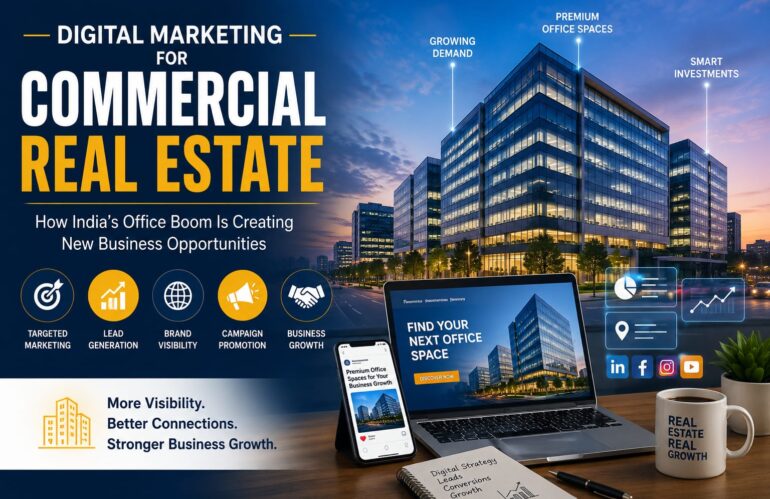
Aug 04: India’s commercial real estate market is no longer simply recovering from the disruption of the pandemic. It is entering a new phase of growth, driven by Global Capability Centres (GCCs), technology companies, multinational businesses and flexible workspace providers.
Office leasing across India crossed 86 million sq ft in 2025, setting a new record. Knight Frank India reported that leasing grew by nearly 20% compared with 2024 and was about 43–44% above pre-pandemic levels. GCCs accounted for nearly 38% of total leasing, while Bengaluru, Hyderabad, NCR, Pune and Chennai each crossed the 10 million sq ft mark.
For commercial real estate companies, these numbers represent more than rising demand. They point to a more competitive market in which developers, landlords, brokers and workspace operators have to work harder to attract the attention of corporate occupiers.
That is where digital marketing for commercial real estate is becoming increasingly important.
A well-planned digital strategy can help property businesses reach companies earlier in their search for office space, generate qualified enquiries and communicate why a particular property or location deserves consideration.
Why Commercial Real Estate Needs a Stronger Digital Presence
Finding office space is a major decision for any company. Corporate occupiers may compare several buildings and locations before making a shortlist.
They may research connectivity, rental costs, amenities, floor plates, technology infrastructure, sustainability credentials, employee facilities and future expansion possibilities.
Much of that research can begin online.
A business looking for office space in Hyderabad, Bengaluru or Pune may first search Google, explore property websites, read market reports, check professional networks or watch property videos before contacting a broker or developer.
This means a commercial property needs to be visible well before the final leasing conversation begins.
Digital marketing can help real estate businesses build that visibility through SEO, content marketing, social media, digital PR, paid campaigns and lead-generation strategies.
SEO Can Help Commercial Properties Get Found
Search engine optimisation is particularly valuable for commercial real estate because potential occupiers often search with specific requirements.
Someone may search for:
- Grade A office space in Hyderabad
- Commercial office space in Bengaluru
- Office space for GCCs in India
- Managed office space for enterprises
- Commercial property in Pune
- Corporate office space in Chennai
If a property company has useful, well-optimised pages for these searches, it has a better chance of reaching businesses that are already looking for a solution.
SEO should not be limited to property listings. Companies can also create location guides, office market updates, leasing insights and articles about workplace trends.
The aim is simple: be visible when potential customers are searching for what the business offers.
Content Marketing Can Explain What Makes a Property Different
A commercial property website cannot rely only on photographs, floor plans and contact forms.
Today’s corporate occupiers are looking at the bigger workplace experience.
They want to know about connectivity, employee amenities, sustainability, technology infrastructure, nearby services and the ability to scale as their business grows.
Content marketing provides an opportunity to explain these advantages.
Real estate companies can publish:
- Office leasing trends
- Location guides
- GCC expansion insights
- Workplace transformation articles
- Commercial property reports
- Sustainability initiatives
- Tenant case studies
- Expert interviews
- Investment insights
- Flexible workspace trends
Useful content can also build credibility. Instead of appearing online only when a property is available for lease, a company can become a regular source of information for businesses following the commercial real estate market.
GCC Expansion Creates a Major Marketing Opportunity
The rise of GCCs is particularly important for India’s office market. Knight Frank India says GCCs accounted for nearly 38% of total office leasing in 2025, reflecting their growing role in India’s corporate real estate demand.
For property companies, this creates an opportunity to develop marketing strategies specifically for GCC requirements.
A developer could create content around office space for Global Capability Centres, while a flexible workspace provider could promote scalable offices designed for companies establishing or expanding Indian operations.
This is more effective than promoting every property to the same broad audience.
Targeted digital campaigns can focus on particular industries, locations, company sizes and business requirements, helping sales teams receive more relevant enquiries.
Lead Generation: Turning Online Searches into Real Enquiries
Visibility is only the first step. For commercial real estate businesses, the bigger objective is turning that visibility into conversations with potential occupiers.
This is where lead generation becomes important.
A property company can create dedicated landing pages for individual buildings, locations or office solutions. These pages can include essential information about the property along with clear calls to action such as:
Request a Brochure | Schedule a Site Visit | Speak to a Leasing Expert | Check Availability
Search engine optimisation can bring organic visitors to these pages, while paid search and social media campaigns can reach specific corporate audiences.
Lead forms, enquiry tracking and analytics can then help sales teams understand where potential customers are coming from.
This creates a more measurable connection between digital marketing and leasing activity.
Social Media Can Keep Property Brands Visible
Commercial real estate may be a traditional industry, but social media can play an important role in maintaining brand visibility.
LinkedIn is particularly relevant for reaching corporate decision-makers, business leaders, investors, brokers and real estate professionals.
Property companies can share:
- New project announcements
- Leasing milestones
- Property launches
- Market insights
- Leadership opinions
- Tenant stories
- Workplace trends
- Sustainability initiatives
Visual content can also bring properties to life through office tours, building photographs, amenities, architecture and short videos.
The objective is not to post simply for the sake of being active. Content should consistently reinforce what the property brand stands for and why its offerings matter to corporate occupiers.
Digital PR Can Build Trust Around the Brand
Major real estate developments often have stories that deserve wider attention.
New projects, large leasing transactions, expansion plans, investments, partnerships and sustainability initiatives can all become opportunities for digital PR.
Industry leaders can also contribute expert opinions on topics such as GCC expansion, office demand, workplace transformation and commercial real estate trends.
Coverage in relevant business and industry publications can help strengthen credibility while creating additional online visibility.
When digital PR is combined with SEO and content marketing, the impact can extend beyond a single news announcement.
Data Can Make Real Estate Marketing More Effective
Digital marketing should not stop at website traffic or social media engagement.
Real estate companies need to understand whether their marketing is generating meaningful business opportunities.
Analytics can help track:
- Website visitors
- Property-page engagement
- Search rankings
- Enquiry volumes
- Lead sources
- Landing-page conversions
- Campaign performance
- Social media engagement
For example, if analytics show that a particular property receives significant traffic from searches related to GCC office space, the marketing team can develop more content and campaigns around that audience.
This makes marketing decisions more evidence-based and allows companies to focus their budgets on channels that are producing relevant leads.
Modern Offices Need Modern Marketing
The growth of India’s office market is also changing what companies expect from workplaces.
Knight Frank India notes that the 2025 market was driven by GCCs, third-party IT services and flexible and managed office providers. The consultancy also highlighted the growing importance of quality, agility and workplace transformation.
That gives property companies more stories to tell.
A modern office can be marketed around its technology infrastructure, employee amenities, sustainability features, connectivity and flexibility rather than simply its square footage.
Videos, virtual tours, photographs, case studies and interactive website content can help prospective occupiers understand the experience before they schedule a physical visit.
A Practical Digital Marketing Framework for Commercial Real Estate
For commercial real estate businesses, an effective digital strategy can bring several channels together rather than relying on one marketing activity.
SEO can improve organic visibility.
Content marketing can demonstrate industry knowledge and property value.
Social media can maintain engagement with professional audiences.
Digital PR can build credibility and expand reach.
Paid campaigns can target businesses actively looking for office solutions.
Landing pages and lead forms can turn visitors into enquiries.
Analytics can measure performance and identify opportunities for improvement.
Together, these activities can create a digital marketing funnel that moves a potential customer from search → discovery → consideration → enquiry → site visit → leasing conversation.
The Opportunity Ahead for Commercial Real Estate Brands
India’s record office leasing activity shows that the commercial real estate market is becoming increasingly important to the country’s broader business ecosystem. With GCCs, technology companies, multinational businesses and flexible workspace providers contributing to demand, competition for corporate occupiers is likely to remain strong.
For developers, landlords, brokers and workspace operators, having a strong property portfolio is only part of the equation.
The other part is making sure the right businesses know about it.
Digital marketing for commercial real estate can help bridge that gap by combining search visibility, useful content, targeted campaigns, digital PR and measurable lead generation.
The opportunity is therefore bigger than simply advertising available office space. It is about building a digital-first real estate brand that reaches the right businesses, communicates the right value proposition and turns online interest into genuine leasing opportunities.