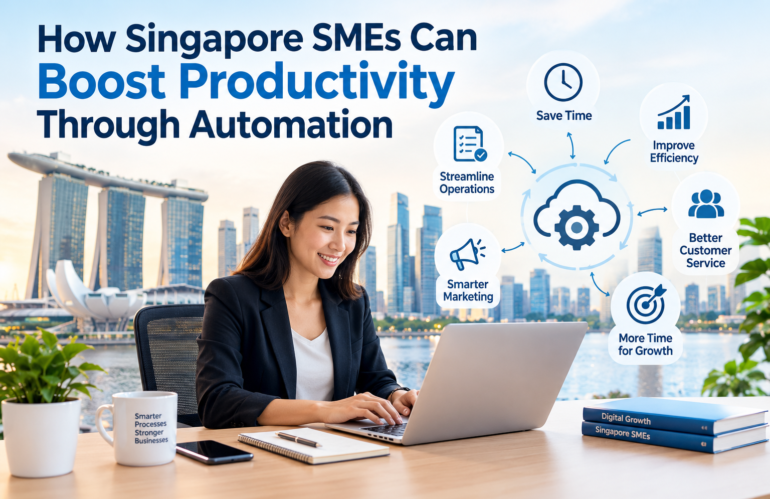
Oct 24: Business automation in Singapore is helping companies find practical ways to save time, manage daily operations and improve customer service. From responding to website enquiries to organising sales leads and scheduling marketing campaigns, businesses can use digital tools to reduce repetitive work and focus on activities that support growth.
For small and medium-sized enterprises (SMEs), automation does not have to involve expensive technology or a complete overhaul of existing systems. It can begin with simple changes, such as sending appointment reminders automatically, organising customer information or creating a consistent process for following up on enquiries.
As Singapore’s digital economy expands, businesses that adopt the right automation tools can improve efficiency, support employees and build a stronger foundation for long-term growth.
Why Business Automation Matters in Singapore
Singapore’s competitive business environment makes productivity and efficient resource management important for companies of all sizes. Smaller businesses, in particular, need to balance customer service, marketing, administration and sales without allowing routine tasks to consume too much time.
The Infocomm Media Development Authority’s Singapore Digital Economy Report 2025 found that 95.1% of Singapore SMEs had adopted at least one of the six digital areas measured in 2024, compared with 94.5% in 2023. The report also recorded an increase in AI adoption among SMEs, from 4.2% in 2023 to 14.5% in 2024.
These figures show that digital adoption is becoming more widespread, although adopting digital tools does not automatically mean a business has automated its workflows. Companies still need to identify where technology can solve practical problems and deliver measurable benefits.
For Singapore SMEs, the opportunity lies in using automation to reduce unnecessary manual work, improve consistency and make better use of employees’ time.
What Is Business Automation?
Business automation involves using software and digital systems to complete repetitive tasks with less manual intervention. Depending on the workflow, a system might follow predefined rules, transfer information between applications or use artificial intelligence to assist with certain activities.
Common examples include sending automated emails, updating customer records, generating invoices, scheduling social media posts and notifying employees when an action is required.
Automation can also connect different stages of a business process. For instance, a website enquiry can trigger a confirmation email, create a record in a customer management system and notify the appropriate sales representative.
The purpose is not to eliminate human involvement. Instead, automation can handle predictable tasks while employees concentrate on customer relationships, problem-solving and business decisions.
5 Ways Singapore SMEs Can Use Business Automation
1. Simplify Administrative Tasks
Administrative work can take up a considerable part of the working day. Preparing recurring documents, entering information into spreadsheets, sending reminders and updating records may be necessary, but these tasks do not always require manual attention.
Automation tools can help businesses generate standard documents, transfer information between systems and send notifications when deadlines approach.
For example, a consultancy could automate meeting confirmations and follow-up reminders. A distributor could receive a notification when stock falls below a set level, helping employees respond before shortages disrupt operations.
The best starting point is usually a task that occurs frequently, follows clear rules and consumes time without requiring complex judgement.
2. Improve Customer Communication
Customers expect businesses to respond promptly when they request information, enquire about services or book appointments. Delayed replies can create frustration and may cause potential customers to approach competitors.
Automation can help companies acknowledge enquiries, send booking confirmations and route requests to the right team. Customer management software can also remind employees when a prospective customer needs a follow-up.
However, automated communication should be relevant and helpful. Complex enquiries, complaints and sensitive situations still require personal attention.
Businesses should also make sure their automated messages are accurate, easy to understand and consistent with their customer service standards.
3. Make Digital Marketing More Efficient
Digital marketing involves several ongoing activities, including content planning, publishing, email communication and campaign analysis. Managing these activities manually can become difficult as a company expands.
Marketing automation tools can help businesses schedule social media posts, organise email campaigns, segment audiences and track campaign performance.
For Singapore SMEs, this can make it easier to maintain a consistent online presence while reducing repetitive coordination.
Automation alone, however, will not guarantee better search rankings or more sales. Businesses still need useful content, relevant messaging, a clear understanding of their audiences and a marketing strategy that reflects their goals.
Combining automation with search engine optimisation and effective digital content can help companies manage their marketing activities more systematically.
4. Organise Sales Leads and Follow-Ups
Businesses may receive enquiries through websites, emails, social media and other channels. When these enquiries are managed separately, opportunities can be overlooked and follow-ups may be delayed.
A customer relationship management system can bring enquiries into a central record, assign them to the appropriate employee and create reminders for the next step.
Consider a Singapore-based business consultancy that receives enquiries through its website.
When a potential client submits a form, an automated workflow could:
- Send an acknowledgement email confirming that the enquiry has been received.
- Record the contact details and service requested in a customer management system.
- Notify the relevant sales representative.
- Create a reminder to follow up within the company’s chosen response period.
- Record the outcome so the business can review its lead conversion performance.
This process helps the company organise enquiries and reduce the risk of missing follow-ups. Employees can still review each enquiry and personalise their responses.
The business can then assess whether the workflow improves response times, reduces administrative effort and helps its sales team manage opportunities more effectively.
5. Improve Reporting and Business Decisions
Preparing reports manually can be time-consuming, especially when information comes from several systems.
Automated dashboards can bring selected data together, allowing business owners to monitor sales activity, customer enquiries, campaign performance or operational progress.
For example, a company could review the number of enquiries received each week, the time taken to respond and the proportion that progress to a sales conversation.
These insights can help managers identify bottlenecks and make more informed decisions about staffing, marketing and operational priorities.
The results are only as reliable as the underlying data. Businesses should review their reports regularly and investigate unusual changes rather than relying on automated summaries without context.
How Singapore SMEs Can Start Automating Their Workflows
Businesses do not need to automate every department at once. A phased approach can help them control costs and understand which changes deliver genuine value.
Step 1: Identify repetitive work. List tasks that involve frequent data entry, manual updates, reminders or routine follow-ups.
Step 2: Choose one business problem. Start with a process that consumes time, causes delays or creates avoidable errors.
Step 3: Select a suitable tool. Compare the cost, features, security, ease of use and compatibility of available software.
Step 4: Test the workflow. Run a pilot with a small team or limited number of transactions before expanding its use.
Step 5: Train employees. Explain how the system works, when manual intervention is needed and how mistakes should be reported.
Step 6: Measure the outcome. Compare processing time, error rates, response times and relevant costs before and after implementation.
This method helps businesses evaluate automation based on real outcomes instead of adopting technology simply because it is available.
Common Challenges of Business Automation
Although automation can improve efficiency, it needs to be planned carefully.
The cost of software, integration with existing systems and employee training can be challenging for smaller businesses. Poorly designed workflows may also reproduce mistakes automatically or create confusion when information moves between applications.
Data protection deserves particular attention. Businesses should consider who can access customer information, how long it is retained and how third-party providers manage it. Companies handling personal data should assess their obligations under Singapore’s Personal Data Protection Act, where applicable.
Another important consideration is the process itself. If an existing workflow contains unnecessary steps, automating it without reviewing its design may simply make an inefficient process run faster.
Businesses should simplify their operations first, then introduce automation where it can make a meaningful difference.
Automation is one part of a broader business growth strategy. Efficient internal systems can help companies manage enquiries and daily operations, but businesses also need to establish their online presence and reach relevant audiences.
The Future of Business Automation in Singapore
As digital tools become more accessible, Singapore businesses have opportunities to improve workflows across administration, customer service, sales, marketing and reporting.
AI-enabled systems may also assist with activities such as document processing, information analysis and customer support. However, the appropriate solution depends on the business’s needs, available resources and tolerance for operational risk.
Companies should evaluate tools based on the problems they solve, the effort required to maintain them and the benefits they deliver. They should also check current official requirements before relying on government grants or assuming a particular solution qualifies for financial support.
Successful automation is not about using the largest number of tools. It is about creating simpler, more reliable processes that save time and help employees work more effectively.
Conclusion
Business automation in Singapore offers SMEs a practical way to simplify operations, improve customer communication and make better use of limited resources. From administrative tasks and marketing activities to lead management and reporting, businesses can begin with small changes and expand as their requirements evolve.
The most effective approach is to identify a genuine business problem, choose a suitable solution and measure the results before automating additional processes.
For companies looking to improve operational efficiency while strengthening their online visibility, Shreyas Webmedia Solutions can support the digital content, publishing and marketing activities that complement a wider growth strategy.
Combining practical automation with a consistent digital presence can help Singapore businesses manage their work more efficiently and build stronger connections with potential customers.
Shreyas Webmedia Solutions supports businesses through digital content, publishing, digital marketing and lead-generation-related services. These activities can complement automation by helping companies communicate their value, improve online visibility and attract potential customers.