Why Digital Twins Are Becoming Important for Modern Businesses
Businesses are increasingly using data, automation and artificial intelligence to improve the way they operate. But collecting data is only one part of the challenge. Companies also need to understand what that data means and how changes in one part of an operation could affect the rest of the business.
This is where digital twins are gaining importance.
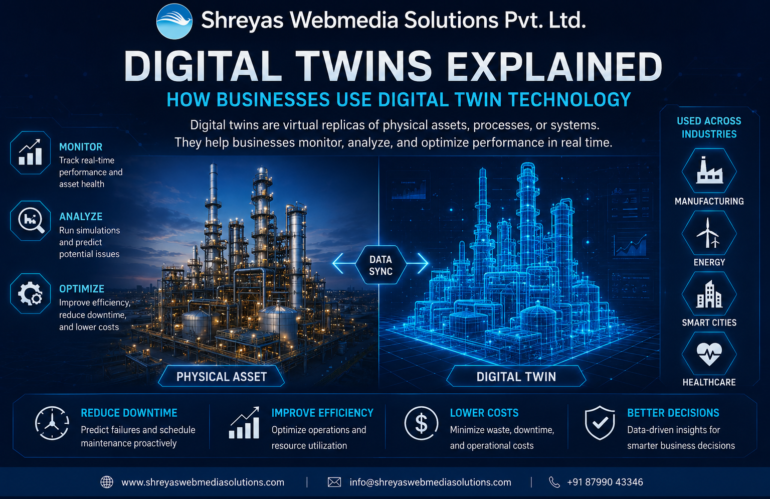
A digital twin is a virtual representation of a physical asset, process or system that uses real-world data to monitor performance, simulate scenarios and support decision-making. Instead of simply showing what an asset looks like, a digital twin can help businesses understand how that asset is performing and how it could behave under different conditions.
The technology is being developed alongside the Internet of Things (IoT), artificial intelligence (AI), cloud computing, edge computing and advanced analytics. Together, these technologies are helping businesses create a closer connection between their physical operations and digital systems.
According to the U.S. National Institute of Standards and Technology (NIST), digital twins can support monitoring, prediction, optimization and decision-making across physical systems. NIST also identifies applications in areas such as machine health, maintenance and manufacturing.
What Is a Digital Twin?
A digital twin is a virtual representation of a physical asset, process or system that uses real-world data to monitor performance, simulate scenarios and support decision-making.
A digital twin can represent something as small as an industrial machine or as complex as an entire manufacturing facility.
For example, sensors attached to a production machine can continuously collect information about temperature, vibration, pressure, energy consumption and operating speed. That information can feed into the machine’s digital twin.
Engineers can then use the digital twin to understand the machine’s current condition, identify unusual patterns and examine how it may respond to different operating conditions.
This makes digital twins different from conventional digital models. A basic digital model may simply represent an object or process, while a digital twin can be connected to real-world data and updated as the physical system changes.
How Does Digital Twin Technology Work?
Digital twin technology brings together several technologies to create a digital connection with the physical world.
Internet of Things
IoT sensors collect information from physical equipment. Depending on the application, they can monitor temperature, pressure, vibration, movement, energy consumption and other variables.
Data and Cloud Platforms
The collected information can be transferred to data platforms where it is stored, processed and analyzed. Cloud computing can support large-scale data processing, while edge computing can process information closer to the physical asset when faster responses are required.
Artificial Intelligence
AI and machine learning can analyze large amounts of operational data. These systems can help identify patterns, detect anomalies and generate predictive insights.
Simulation
Businesses can use digital twins to simulate different scenarios. For example, a manufacturer can examine what might happen if production speeds increase or a particular component is replaced.
This allows companies to evaluate possible changes before introducing them to a real-world operation.
Digital Twin Market Expected to Expand
The growing interest in digital twin technology is reflected in several industry forecasts.
A MarketsandMarkets report published in 2025 estimated the global digital twin market at $21.14 billion in 2025 and projected it to reach $149.81 billion by 2030, representing a compound annual growth rate of 47.9%.
Another forecast from Fortune Business Insights estimated the global market at $24.48 billion in 2025 and projected it to reach $384.79 billion by 2034.
The estimates vary considerably because research companies use different methodologies and definitions of the digital twin market. They should therefore not be treated as directly comparable figures. However, both forecasts point toward strong expected growth in the technology.
How Businesses Use Digital Twins
1. Predictive Maintenance
One of the most established digital twin applications is predictive maintenance.
Industrial equipment can be expensive to repair and even more expensive when an unexpected failure stops production. Digital twins allow businesses to continuously monitor the condition of machinery.
For example, an increase in vibration or temperature could indicate that a component is beginning to deteriorate. Instead of waiting for the equipment to fail, maintenance teams can investigate the issue and potentially intervene earlier.
NIST identifies machine health and maintenance as important applications of digital twins.
The result can be better maintenance planning, improved equipment utilization and potentially less unplanned downtime.
2. Smart Manufacturing
Manufacturing is another major area for industrial digital twins.
Companies can create digital twins of individual machines, production lines or complete factories. Engineers can use these digital environments to identify bottlenecks, monitor production performance and test process improvements.
Suppose a manufacturer wants to increase production speed. Rather than immediately changing the physical production line, engineers can first use a digital twin to examine the potential impact on equipment, energy consumption and production capacity.
This can support more informed decisions while reducing the risks associated with making changes directly on the factory floor.
3. Product Design and Development
Digital twins can also support the development of new products.
Engineers can create digital representations of products and evaluate their performance under different conditions. Potential design changes can be tested virtually before physical production.
This can be particularly valuable in industries such as automotive, aerospace and industrial equipment, where developing and testing physical prototypes can require considerable time and resources.
Digital twins can therefore complement traditional engineering and prototyping processes.
4. Energy and Utilities
Energy companies operate complex infrastructure that requires continuous monitoring.
Digital twins can represent turbines, power-generation equipment, electrical systems and renewable energy assets. By combining operational information with digital models, companies can gain a clearer picture of asset performance.
Businesses can also use the technology to examine different operating scenarios and identify potential inefficiencies.
As energy infrastructure becomes increasingly connected and decentralized, digital twins could become more useful for monitoring and optimizing complex systems.
5. Buildings and Smart Infrastructure
Digital twins are also being used in buildings and infrastructure.
A building digital twin can combine information from heating and cooling systems, electricity networks, occupancy sensors and other connected equipment.
Facility managers can use this information to monitor building performance, understand energy consumption and identify equipment that may require maintenance.
The concept can also be extended to larger infrastructure projects, including industrial facilities and transportation systems.
6. Supply Chain Management
Modern supply chains involve multiple interconnected processes. A disruption at one point can affect production, inventory and deliveries elsewhere.
Digital twins can provide companies with a virtual representation of warehouses, transportation networks, inventory flows and production capacity.
Businesses can use these models to simulate scenarios such as supplier delays, transportation disruptions or sudden increases in customer demand.
This can help companies assess possible responses before implementing them and improve overall supply chain resilience.
Digital Twins and India’s Industrial Transformation
India’s growing focus on manufacturing, infrastructure, digital transformation and automation creates several potential applications for digital twins.
Manufacturers can use the technology to monitor production equipment and improve factory operations. Automotive and engineering companies can use virtual models during product development, while infrastructure operators can use digital representations to monitor complex assets.
The technology also has potential applications in smart buildings, logistics, energy, transportation and industrial automation.
For Indian businesses, the value of digital twins could increasingly come from connecting existing investments in IoT, AI and automation rather than treating the technology as an isolated solution.
As more industrial assets become connected, the availability of real-time operational data can provide the foundation for increasingly sophisticated digital twin applications.
Key Benefits of Digital Twin Technology
Businesses adopting digital twins can potentially gain several advantages:
- Improved operational visibility: Real-time data can provide a clearer view of asset performance.
- Predictive maintenance: Companies can identify warning signs before equipment failures occur.
- Reduced downtime: Earlier intervention can help minimize unexpected disruptions.
- Better resource utilization: Businesses can examine how equipment, energy and materials are being used.
- Faster decision-making: Digital simulations allow teams to assess different options.
- Improved product development: Virtual testing can complement physical prototypes.
- Greater operational efficiency: Digital twins can help identify bottlenecks and inefficiencies.
Challenges Businesses Need to Consider
Despite the potential benefits, implementing digital twin solutions can be complex.
Data Quality
Digital twins depend on reliable data. Inaccurate, incomplete or inconsistent sensor information can reduce the reliability of the digital representation.
Integration With Existing Systems
Businesses may need to connect digital twins with IoT networks, enterprise software, manufacturing systems and older infrastructure. This can make implementation technically challenging.
Cybersecurity
Connected digital twins can interact with operational technology and business systems. Protecting the underlying data and infrastructure is therefore critical.
Cost and Skills
Developing sophisticated digital twins can require investment in sensors, software, computing infrastructure and skilled professionals with expertise in engineering, data analytics, IoT and AI.
NIST has also highlighted issues such as interoperability, standards, trustworthiness and verification as important considerations for digital twins, particularly in manufacturing.
AI Could Make Digital Twins More Intelligent
The next stage of AI-powered digital twins could move the technology beyond monitoring and simulation.
A traditional digital twin can help businesses understand what is happening to an asset. AI can potentially help answer what could happen next and what action might be appropriate.
For example, an AI system could analyze equipment data, identify signs of deterioration and alert maintenance teams to a potential problem.
Research from Tata Consultancy Services has highlighted the convergence of digital twins with generative AI, physical AI and agentic AI, pointing toward more predictive and intelligent industrial applications.
This could eventually allow digital twins to become active decision-support systems rather than simply digital representations of physical assets.
What Is the Future of Digital Twins?
Digital twins are likely to become increasingly connected as businesses deploy more IoT devices and AI-based systems.
Instead of creating a digital twin for only one machine, companies could connect multiple digital twins representing machines, factories, warehouses, transportation networks and supply chains.
This could create a broader digital ecosystem in which information flows between different parts of an organization.
The combination of AI, IoT, cloud computing, edge computing and automation could make digital twins increasingly valuable for companies seeking to predict problems, optimize operations and respond faster to changing conditions.
Conclusion
Digital twins are helping businesses connect the physical and digital worlds in a more practical way. By combining real-world data with digital models, companies can monitor assets, predict potential problems, simulate changes and make more informed decisions.
The technology is already finding applications in predictive maintenance, smart manufacturing, product development, energy, buildings and supply chain management. Its relevance is also growing as businesses invest in AI, IoT and industrial automation.
While challenges involving data quality, cybersecurity, integration, cost and technical expertise remain, the potential of digital twins extends well beyond virtual modeling.
As businesses become increasingly data-driven, digital twin technology could become an important part of the next generation of intelligent operations—helping companies move from reacting to problems toward predicting and preventing them.