
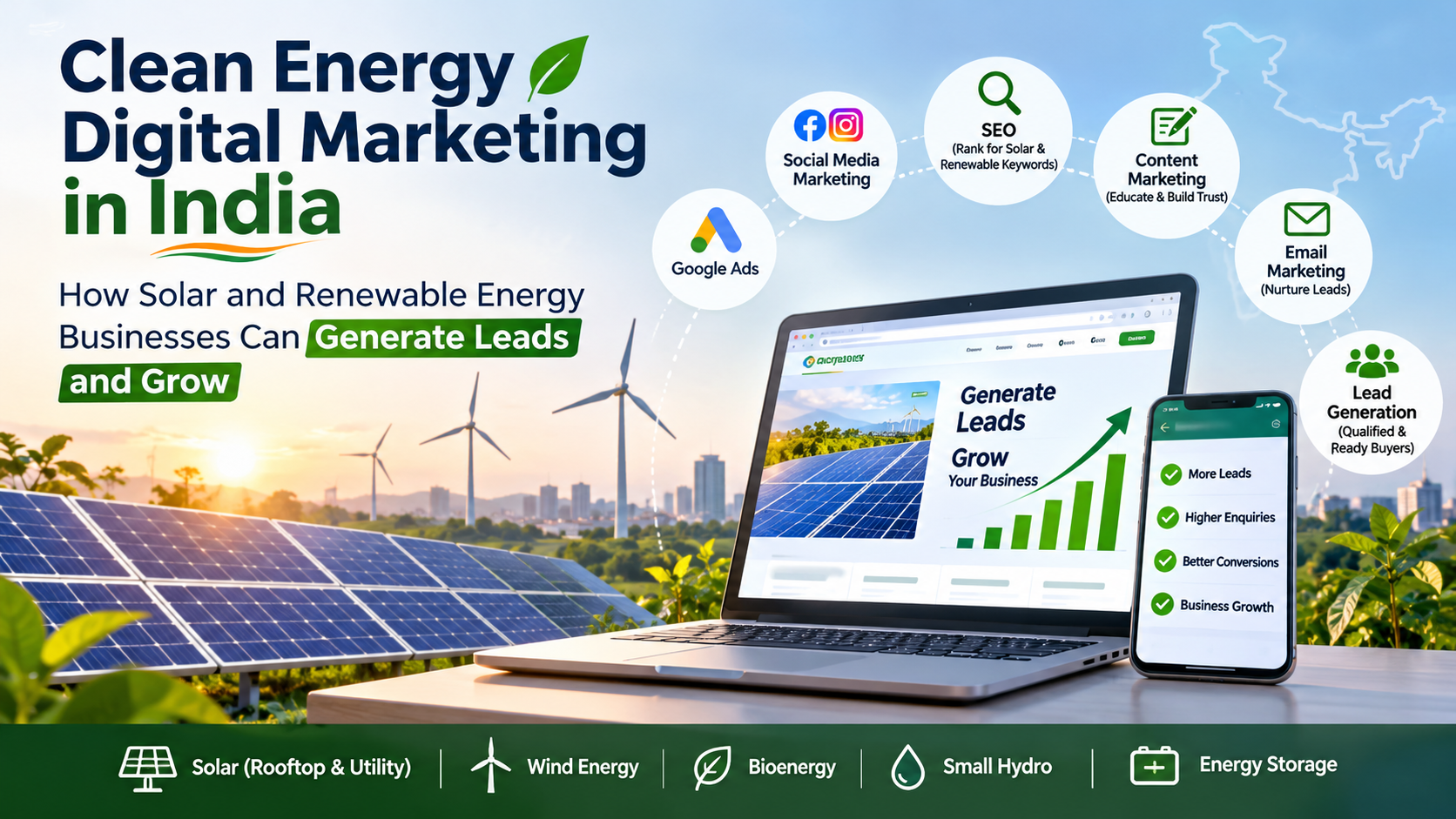
Nov 14: India’s growing clean energy sector is creating opportunities for businesses involved in solar power, wind energy, electric mobility, battery storage and energy-efficient technologies. As households and organisations explore alternatives to conventional energy, companies need effective ways to explain their solutions, reach potential customers and stand out in a competitive market.
Clean energy digital marketing in India is becoming an important part of that effort. Through search engine optimisation, content marketing, social media, video campaigns and targeted advertising, renewable energy businesses can connect with residential consumers, commercial buyers and industrial decision-makers.
The opportunity extends beyond large energy producers. Rooftop solar installers, EV charging providers, battery manufacturers, renewable energy equipment suppliers and clean-tech startups can all use digital channels to build visibility, generate qualified enquiries and develop customer relationships.
India’s Clean Energy Market Is Creating New Marketing Opportunities
The scale of India’s renewable energy expansion provides a strong backdrop for businesses looking to grow. A Ministry of New and Renewable Energy update published on November 13, 2026, reported that India’s total installed power capacity had reached around 560 GW in October 2026. Non-fossil fuel capacity stood at 308 GW as of July 31, 2026, accounting for approximately 55% of total installed capacity.
This growth is creating opportunities across several business segments:
-
Solar energy: Rooftop solar installers, solar panel manufacturers and commercial solar solution providers.
-
Wind energy: Turbine manufacturers, project developers and maintenance service providers.
-
Electric mobility: EV charging infrastructure providers, battery manufacturers and fleet electrification companies.
-
Energy storage: Battery technology companies and energy management solution providers.
-
Clean technology: Startups developing energy monitoring, efficiency and renewable energy management solutions.
Each segment has different customers and purchasing requirements. A residential solar installer needs to reach homeowners, while an industrial energy solutions provider may need to connect with factory owners, procurement teams and infrastructure developers. Digital marketing strategies should reflect these differences.
SEO Strategies to Help Renewable Energy Businesses Attract Customers
Search engine optimisation can help clean energy companies reach customers who are already researching products and services.
Potential customers may search for phrases such as “rooftop solar installation in India”, “commercial solar power solutions”, “industrial battery storage” or “EV charging station installation”.
Businesses can develop dedicated service pages, location-based landing pages and informative articles around these searches. Rather than targeting broad keywords alone, companies should focus on search terms that reflect their actual services and customer requirements.
For example, a rooftop solar company operating in Kerala could create dedicated pages for Kochi, Thiruvananthapuram and Kozhikode, provided it genuinely serves those markets. These pages can explain installation services, project requirements, maintenance support and the process for requesting an assessment.
SEO can also support manufacturers and B2B suppliers by making technical product information easier to discover. Detailed pages covering equipment specifications, applications and project capabilities can attract more relevant business enquiries.
Content Marketing Can Explain Complex Clean Energy Solutions
Renewable energy products often involve technical information that customers may find difficult to evaluate. Content marketing gives companies an opportunity to explain these solutions in practical terms.
A solar equipment manufacturer could publish a guide to selecting solar panels, while an energy storage provider could explain battery capacity, backup duration and different applications.
Useful content topics include:
-
Rooftop solar solutions for homes and commercial buildings
-
Solar power systems for factories and warehouses
-
Battery storage for commercial energy management
-
EV charging infrastructure for businesses
-
Energy-efficient technologies for industrial facilities
-
Renewable energy procurement for corporate customers
Project-based content can make these explanations more convincing. A company can describe the requirements of a completed installation, the technology selected and the services provided. Where performance figures or savings are included, they should be supported by verifiable project data.
Social Media Marketing for Solar, EV and Clean-Tech Brands
Social media can help renewable energy businesses reach different customer groups with relevant information.
LinkedIn is particularly useful for B2B companies seeking relationships with industrial buyers, project developers, infrastructure companies and corporate sustainability teams. Businesses can share project updates, technical insights, company announcements and expert perspectives.
Instagram and Facebook can help residential solar companies communicate with homeowners through installation photographs, short videos, customer experiences and educational posts. YouTube can support longer demonstrations and product explainers.
For EV charging companies, content could focus on charging infrastructure for commercial properties, offices, hotels and fleet operators. Battery technology businesses could use visual explanations to show how storage systems work and where they can be used.
The objective should be to make the technology understandable and the company’s capabilities visible, rather than relying only on promotional messages.
Performance Marketing for Qualified Lead Generation
Paid digital campaigns can help clean energy businesses reach people actively looking for specific solutions.
Google Ads can target searches related to solar installation, commercial renewable energy systems, battery storage and EV charging infrastructure. LinkedIn advertising can be useful for reaching business decision-makers, while Meta platforms can support residential and local campaigns.
However, clean energy companies should distinguish between general enquiries and qualified leads. A person looking for information about solar panels may not be ready to purchase, while a factory owner requesting a commercial energy assessment may represent a more immediate business opportunity.
Dedicated landing pages can improve campaign performance by presenting relevant services, project experience, technical information and clear enquiry options.
Companies should monitor the cost of acquiring qualified leads, enquiry-to-consultation rates and the number of enquiries that eventually become customers. This provides a more meaningful assessment of campaign performance than clicks or impressions alone.
Local SEO for Renewable Energy Companies in Kerala
Regional marketing can be particularly valuable for solar installation companies and clean energy service providers.
In Kerala, businesses can build local visibility by developing relevant service pages for the districts and cities they actually cover. A company serving Kochi, for example, could create content around rooftop solar for residential buildings, commercial establishments and industrial facilities.
Maintaining an accurate Google Business Profile, collecting genuine customer reviews and providing updated contact information can also support local discovery.
For service-based companies, the customer experience does not end with an online enquiry. Installation, maintenance and after-sales support are important considerations. Digital communication should therefore explain the company’s service coverage and support capabilities clearly.
Video Marketing Can Make Clean Energy Technology Easier to Understand
Video content can help businesses demonstrate products and services in ways that written content may not achieve as effectively.
Solar companies can show installation processes, completed projects and system components. EV charging providers can demonstrate how charging stations operate, while battery manufacturers can explain storage applications through product demonstrations.
Short videos can be shared across social media platforms, while longer educational content can be published on YouTube. Businesses can also use customer interviews and expert discussions to answer common questions.
A consistent video strategy can help brands communicate technical information while giving potential customers a better understanding of their products and capabilities.
Government Schemes Create Opportunities for Informative Marketing
Government initiatives can provide useful subjects for educational campaigns, particularly for companies serving residential solar customers.
The PM Surya Ghar: Muft Bijli Yojana is designed to encourage rooftop solar adoption among eligible households. The Ministry of New and Renewable Energy’s guidelines set out the scheme’s central financial assistance framework for eligible residential consumers.
Solar installation companies can create content explaining the scheme, the application process and the relevant eligibility conditions. Such information can help customers understand the available options before contacting a service provider.
Businesses must be careful not to promise that every customer will receive a particular subsidy or level of savings. Marketing claims should reflect official guidelines and the customer’s individual circumstances.
Online Reputation and Industry Thought Leadership
For many customers, choosing a clean energy provider involves a substantial financial commitment. Trust and credibility therefore influence purchasing decisions.
Companies can strengthen their online reputation by publishing genuine customer testimonials, verified project details, technical articles and interviews with industry specialists.
B2B companies can also share insights on renewable energy developments, manufacturing capabilities, energy efficiency and emerging technologies. Publishing expert contributions in relevant industry publications can help businesses reach decision-makers beyond their existing customer base.
The emphasis should remain on credible information, demonstrable experience and transparent communication.
Using Data Analytics to Improve Marketing Results
Digital marketing becomes more effective when businesses regularly evaluate the results of their campaigns.
Clean energy companies can monitor organic search traffic, website enquiries, qualified leads, advertising expenditure and customer acquisition costs. They can also identify which locations, products and content topics generate the strongest interest.
For example, a company may discover that searches for commercial rooftop solar generate fewer enquiries than residential solar searches, but a higher proportion of those enquiries convert into projects. Such insights can help businesses allocate their marketing budgets more effectively.
Tracking the customer journey from the first website visit to the final enquiry can also reveal where potential customers lose interest and where improvements are needed.
The Business Opportunity for Clean Energy Digital Marketing in India
India’s clean energy expansion is creating a broader market for businesses offering renewable energy products, services and technologies. However, companies must communicate their offerings effectively to reach customers across residential, commercial and industrial segments.
A solar installer may need local SEO and customer-focused social media campaigns. An equipment manufacturer may benefit from technical content and B2B lead generation. An EV charging provider may need targeted campaigns aimed at commercial property owners and fleet operators.
This makes a single marketing approach unsuitable for the entire sector. Businesses need strategies built around their products, service locations, customer profiles and sales objectives.
Companies that combine informative content, search visibility, credible project communication and targeted advertising can build stronger market recognition and develop more relevant business relationships.
Conclusion
Clean energy digital marketing is becoming an important growth tool for India’s renewable energy businesses. As solar power, wind energy, electric mobility and energy storage continue to develop, companies need effective ways to explain their solutions and reach potential customers.
SEO, content marketing, social media, video campaigns and performance advertising can help renewable energy brands improve online visibility and generate qualified enquiries. More importantly, clear and credible communication can help customers understand the value of clean energy solutions.
For solar companies, clean-tech startups, equipment manufacturers and energy service providers, investing in a focused digital marketing strategy can support long-term brand development and business growth in India’s evolving clean energy market.





Leave a Reply
You must be logged in to post a comment.