India’s e-commerce industry is moving into a more competitive phase. Consumers are no longer dependent on traditional stores to discover products. They can find a brand through a Google search, see a product recommendation on social media, compare prices on marketplaces and complete a purchase from their smartphone.
This changing behaviour has made digital marketing for e-commerce an important part of business growth. For online brands, simply attracting visitors is no longer enough. The bigger challenge is turning visibility into meaningful engagement, purchases and repeat customers.
The opportunity remains substantial. According to data compiled by the India Brand Equity Foundation (IBEF), India’s online retail market was valued at around US$115 billion in 2025 and is projected to reach US$260 billion by 2030. IBEF, citing the Bain & Company–Flipkart outlook, also reports that India’s e-retail market could reach US$170–190 billion in GMV by 2030.
These numbers point to a growing market, but they also indicate rising competition. As more businesses move online, brands need to compete not just for customers but for attention.
Why Digital Marketing Matters for E-commerce
The online buying journey has become fragmented across multiple platforms.
A customer looking for a pair of running shoes, for instance, may first watch a product video on YouTube or Instagram, search Google for reviews, visit a marketplace to compare prices and then go directly to a brand’s website before making a decision.
This means e-commerce marketing cannot rely on a single channel.
A strong digital marketing strategy can help businesses:
- Improve online visibility
- Attract relevant website traffic
- Increase product discovery
- Generate new customers
- Build brand credibility
- Improve conversion rates
- Encourage repeat purchases
- Understand customer behaviour
- Measure marketing performance
The focus is gradually shifting from simply generating traffic to understanding what happens after the customer arrives.
E-commerce SEO Can Build Long-Term Visibility
Search engines continue to play an important role in product discovery. Consumers use them not only to find products but also to research brands, compare alternatives and look for reviews.
This makes e-commerce SEO an important long-term marketing investment.
Product pages, category pages and supporting content can be optimized around relevant search terms and customer intent. Technical elements such as mobile performance, page speed, internal linking and website structure also influence the overall search experience.
Brands should not focus exclusively on broad, highly competitive keywords. More specific searches can sometimes reveal stronger purchase intent.
For example, someone searching for “running shoes” may still be researching. A consumer searching for “lightweight running shoes for daily running under ₹5,000” has provided considerably more information about what they want.
Understanding this difference can help e-commerce marketers create more relevant landing pages and content.
Content Marketing Can Help Build Trust
One challenge with online shopping is that customers cannot physically examine a product before purchasing it.
Content can help reduce that uncertainty.
Buying guides, comparison articles, tutorials, product demonstrations and customer stories can give shoppers the information they need to make a decision.
A furniture brand, for example, could publish content on choosing furniture for compact apartments. A consumer electronics company could create comparison guides explaining the differences between product models. A fashion brand could offer styling suggestions alongside its product collections.
This approach makes content more than an SEO tool. Useful content can become part of the buying experience itself.
It can also help a brand establish expertise and remain visible to consumers who are not yet ready to purchase.
Social Media Is Becoming Part of Product Discovery
Social media has changed how products are introduced to consumers.
A product demonstration, customer review or creator recommendation can create awareness within seconds. Short-form video has made it possible for brands to show products in everyday situations rather than relying only on traditional advertisements.
E-commerce businesses can use social platforms for:
- Product demonstrations
- Customer testimonials
- User-generated content
- Influencer collaborations
- Short-form videos
- Product launches
- Educational posts
- Seasonal campaigns
- Behind-the-scenes content
The strongest social strategies do not make every post a sales pitch. They give consumers reasons to stop, watch, learn and remember the brand.
This is particularly important for newer D2C brands that may not yet have the recognition enjoyed by established companies.
Paid Advertising Can Accelerate Customer Acquisition
Organic visibility is valuable, but it takes time to build. Paid advertising allows e-commerce brands to reach specific audiences more quickly.
Search advertising can capture consumers who are already looking for particular products, while social advertising can introduce products to audiences based on interests, behaviour and other targeting factors.
However, an increase in clicks does not necessarily mean an increase in profitable sales.
E-commerce marketers should pay close attention to metrics such as:
- Conversion rate
- Customer acquisition cost
- Cost per acquisition
- Return on advertising spend
- Average order value
- Customer lifetime value
A campaign generating thousands of visitors but very few purchases may need to be reconsidered, regardless of how impressive its traffic numbers appear.
This is why the focus of performance marketing is increasingly shifting from traffic generation to revenue generation.
Tier-2 and Tier-3 Cities Are Expanding the Market
India’s e-commerce growth story is no longer limited to major metropolitan cities.
Consumers in smaller cities and towns are becoming an increasingly important part of the online shopping ecosystem. IBEF, citing data from Unicommerce, reported that Tier-2 and Tier-3 cities are expected to contribute nearly 66% of new D2C orders in FY26.
For e-commerce brands, this creates an opportunity to reach consumers who may previously have had limited access to certain products.
However, national digital campaigns cannot always assume that consumers across India behave in exactly the same way.
Language, regional preferences, product demand, pricing expectations and purchasing behaviour can differ significantly.
Digital marketing allows businesses to segment audiences and create more relevant campaigns rather than using a single message for the entire country.
Digital Payments Are Supporting E-commerce Growth
The growth of digital payments has also strengthened India’s online commerce ecosystem.
According to government data cited by IBEF, UPI had 55.49 crore users by June 2026 and processed 24,161.69 crore transactions worth ₹314.23 lakh crore during FY26.
For e-commerce businesses, convenient digital payments can reduce friction at checkout. But payment convenience alone does not guarantee a completed purchase.
A customer may abandon a cart because of unexpected delivery charges, a complicated checkout process, slow website performance or uncertainty about returns.
This highlights an important point for digital marketers: marketing does not end when the customer clicks an advertisement.
The experience that follows the click can determine whether that marketing investment produces revenue.
AI Is Bringing More Personalization to E-commerce
Artificial intelligence is becoming increasingly relevant to online retail and digital marketing.
Businesses can use AI and automation for customer segmentation, personalized recommendations, chatbots, automated communication, predictive analysis and advertising optimization.
Personalization is particularly important because consumers are exposed to a large volume of online content every day.
Instead of showing every customer the same product recommendations, businesses can use behavioural data to create more relevant experiences.
AI is also contributing to developments such as visual commerce and conversational shopping, allowing consumers to interact with products and brands in new ways.
The important consideration for businesses, however, is not simply adopting AI because it is a popular technology. The real value comes from using it where it can improve customer experience, reduce repetitive work or support better marketing decisions.
Marketplace Marketing Needs Attention
For many e-commerce brands, the company website is only one part of the sales strategy.
Marketplaces can provide access to large audiences, but they also create intense competition. A product may appear alongside dozens of similar listings, making visibility particularly important.
Marketplace marketing can involve:
- Optimized product titles
- Search-friendly descriptions
- High-quality images
- Customer reviews
- Ratings
- Sponsored listings
- Competitive pricing
- Promotional campaigns
- Marketplace analytics
Brands should also maintain consistency between their marketplace presence, website and social media channels.
A customer who discovers a brand on one platform should be able to recognize the same brand when they encounter it elsewhere.
Data Is Becoming More Important Than Vanity Metrics
One of the strongest advantages of digital marketing is the ability to measure the customer journey.
Rather than focusing only on followers, impressions or clicks, e-commerce businesses can track:
Website Visit → Product View → Add to Cart → Checkout → Purchase → Repeat Purchase
This sequence can reveal where potential customers are dropping out.
For example, strong website traffic combined with low product-page engagement may indicate a content or targeting problem. High product views but low purchases could point toward pricing, trust, product information or checkout issues.
Metrics such as organic traffic, conversion rate, cart abandonment, customer acquisition cost, repeat purchase rate and customer lifetime value therefore become increasingly important.
The result is a shift from marketing decisions based largely on assumptions toward decisions supported by customer data.
E-commerce Brands Need More Than Discounts
Discounts can attract customers, but competing primarily on price can be difficult to sustain.
As the number of online brands grows, businesses need to give consumers other reasons to choose them.
A strong brand identity, useful content, reliable service, positive reviews, personalized communication and a smooth shopping experience can all influence the final purchasing decision.
This is where digital marketing has evolved.
It is no longer simply about placing an advertisement in front of a potential customer. It is about being discovered at the right time, answering questions, building trust and making the purchase journey easier.
The Future of Digital Marketing for E-commerce
India’s e-commerce ecosystem is likely to become more diverse as D2C businesses, marketplaces, social commerce, digital payments, AI-powered shopping and consumers from smaller cities continue to expand.
For marketers, this means there is no single channel that can guarantee sustainable growth.
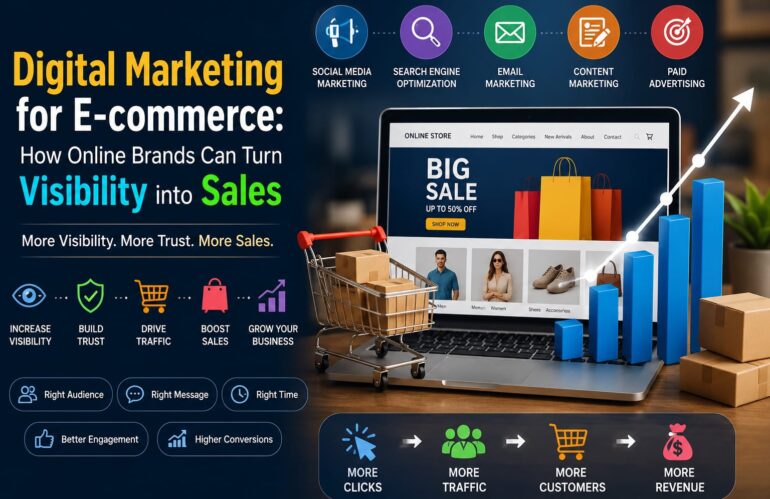
SEO can help consumers discover a brand. Content can help answer their questions. Social media can create awareness. Paid campaigns can accelerate reach, while analytics and AI can help businesses understand what customers actually want.
The opportunity lies in bringing these channels together.
An e-commerce brand that generates traffic but fails to convert customers has a marketing problem. A brand that generates one-time purchases but cannot retain customers has a retention problem. And a business that acquires customers only through expensive advertising may eventually face a profitability challenge.
The more sustainable approach is to build an ecosystem in which organic visibility, paid acquisition, customer experience and retention work together.
Conclusion
The growth of India’s e-commerce industry is creating opportunities for businesses of every size, but the competition for consumer attention is growing at the same time.
Digital marketing can help e-commerce brands navigate this environment by connecting search visibility, content, social media, paid advertising, marketplace presence, personalization and data analytics.
The most successful strategies will not necessarily be those that generate the most clicks. They will be those that turn attention into qualified traffic, qualified traffic into customers and customers into long-term relationships.
As India’s online retail market continues to expand, businesses that treat digital marketing as a measurable growth function rather than simply an advertising expense will be better positioned to build sustainable online sales and stronger customer relationships.