
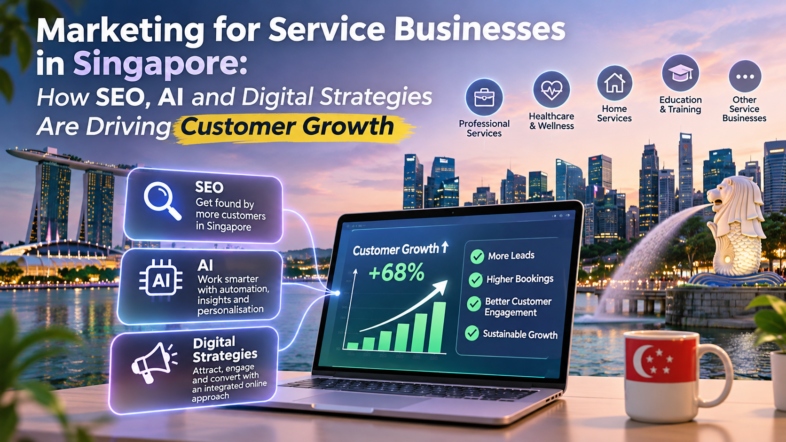
Nov 18: Singapore’s service sector is becoming increasingly competitive as customers rely on online searches, reviews, social media and digital recommendations to choose providers. For businesses offering consulting, healthcare, financial, technology, legal, education and professional services, having a strong digital presence is no longer simply an advantage. It is an important part of building credibility and attracting new customers.
Marketing for service businesses in Singapore is also changing as artificial intelligence, data analytics and evolving search behaviour influence how customers discover and evaluate providers. Businesses must therefore look beyond traditional advertising and develop strategies that connect visibility with trust, lead generation and long-term customer relationships.
The opportunity is supported by Singapore’s wider digital transformation. However, digital adoption alone does not guarantee business growth. Service providers need to understand their target audiences, communicate their expertise and use the right channels to turn online interest into enquiries and paying customers.
Singapore’s Digital Economy Is Creating New Marketing Opportunities
Singapore’s digital economy reached S$144.1 billion in 2025, accounting for 19.3% of the country’s GDP, according to figures reported from the Infocomm Media Development Authority’s (IMDA) Singapore Digital Economy Report 2026. The expansion reflects the growing role of digital technology across both technology and non-technology industries.
Digital adoption among Singapore enterprises also increased from 95.1% in 2024 to 96.4% in 2025. Among small and medium-sized enterprises (SMEs), AI adoption rose from 14.5% to 23.4% over the same period.
These developments have direct implications for service providers. Customers increasingly expect businesses to offer accessible websites, convenient enquiry channels, relevant information and responsive communication. Companies that combine these capabilities with a clear marketing strategy can improve their ability to compete for customers.
Search Engine Optimisation Remains Essential for Customer Discovery
Search engine optimisation (SEO) continues to be an important part of marketing for service businesses in Singapore. Customers frequently use search engines to compare providers, investigate professional credentials, understand service costs and find solutions to specific problems.
For example, a business searching for a management consultant may use phrases such as “business consulting services in Singapore” or “management consulting firms for SMEs”. Similarly, potential patients may search for specialist clinics, while companies looking for technology support may search for cybersecurity consultants or managed IT services.
Service providers can improve their visibility by targeting relevant search terms and developing informative website content.
Important SEO activities include:
-
Local SEO: Optimising business profiles, contact details and location-specific website pages to improve visibility in local searches.
-
Service-specific landing pages: Creating dedicated pages for individual services rather than placing every offering on one general page.
-
Educational content: Publishing articles that address customer questions, industry developments and common business challenges.
-
Technical SEO: Improving website speed, mobile usability, navigation and indexing.
-
Reputation signals: Displaying genuine customer testimonials, professional credentials and relevant business information.
For service businesses, attracting relevant visitors is more valuable than generating large amounts of untargeted website traffic. SEO strategies should therefore focus on search terms that indicate genuine interest in a service.
AI Is Changing How Service Businesses Approach Marketing
Artificial intelligence is becoming an increasingly important tool for business operations and marketing. Singapore’s latest digital economy findings show that AI adoption among enterprises increased significantly in 2025, with professional services recording an adoption rate of 34.5%, compared with 25.7% in 2024.
For service businesses, AI can support several marketing activities, including content planning, customer communication, lead management, campaign analysis and audience segmentation.
A consulting firm, for example, can use AI-assisted research tools to identify frequently discussed industry challenges and develop relevant educational content. A healthcare provider may use automated systems to manage routine appointment enquiries, while an IT services company can use customer relationship management tools to organise leads and monitor follow-ups.
AI can also help businesses analyse customer behaviour and identify patterns in enquiries, website visits and campaign performance.
However, automation should support rather than replace professional judgement. Marketing messages need to remain accurate, relevant and consistent with the company’s expertise. Businesses should also review AI-generated content before publication and protect customer information when using digital tools.
Content Marketing Helps Build Professional Credibility
Service businesses often sell expertise, experience and trust rather than physical products. Customers may spend considerable time evaluating a provider before making a decision, particularly when the service involves financial, legal, technical or operational commitments.
Content marketing helps businesses demonstrate their knowledge before a customer makes contact.
Useful content formats include:
-
Industry insights and expert commentary.
-
Articles explaining complex services in accessible language.
-
Case studies that demonstrate measurable business outcomes, where client permission is available.
-
Interviews with industry specialists.
-
Practical guides and educational resources.
-
Research-based articles addressing emerging market developments.
For example, a business consulting firm can publish articles on operational efficiency, digital transformation and business expansion. A cybersecurity provider can explain common security risks and the importance of risk assessments. An accounting firm can create educational material about financial planning and business compliance.
The objective is not simply to publish frequently. Content should answer genuine customer questions and demonstrate why the business is qualified to provide the service.
Social Media Marketing Supports Brand Visibility and Engagement
Social media platforms offer service businesses opportunities to reach professional audiences, communicate expertise and maintain relationships with existing customers.
In Singapore, LinkedIn can be particularly useful for B2B service providers, including management consultants, technology companies, recruitment firms and professional agencies. Businesses can use the platform to share industry insights, company updates, leadership commentary and service-related information.
Instagram and Facebook can support businesses with more consumer-facing services, such as wellness, education, hospitality, home improvement and lifestyle-related offerings.
Short-form videos, expert discussions, customer stories and informative graphics can help make complex services easier to understand. However, businesses should select platforms based on their target audience rather than trying to maintain an active presence everywhere.
A consistent social media strategy should connect content with a clear business objective, such as website visits, enquiries, event registrations or customer engagement.
Online Reputation Influences Customer Decisions
Trust plays a significant role in service-related purchasing decisions. Customers may compare several providers before selecting a company, making online reviews, testimonials and professional credentials important parts of the decision-making process.
A strong online reputation can help a business establish credibility and reduce uncertainty among potential customers.
Service providers should encourage genuine customers to share feedback, respond professionally to reviews and ensure that business information remains accurate across relevant online platforms.
For professional services, reputation management should also extend to leadership visibility. Articles, interviews, expert commentary and participation in industry discussions can help position business leaders as knowledgeable voices in their respective fields.
Public relations and digital marketing can complement one another in this area. Relevant media coverage can expand brand exposure, while consistent website and social media communication can help potential customers understand the company’s expertise.
Industry-Specific Marketing Strategies Can Improve Lead Generation
A broad digital marketing campaign may not deliver the same results across every service category. Each industry has different customer expectations, purchasing cycles and decision-making processes.
Service providers should therefore align their marketing strategies with the needs of their target markets.
Business Consulting and Management Services
Consulting firms can focus on thought leadership, industry research, LinkedIn marketing and SEO-driven articles. Content covering business transformation, operational efficiency, market entry and management challenges can attract decision-makers seeking specialist support.
Healthcare and Wellness Services
Healthcare providers can use local SEO, educational content, patient communication and reputation management to improve visibility. Their marketing should prioritise accurate information, professional standards and responsible communication.
IT and Cybersecurity Services
Technology companies can develop content explaining cybersecurity risks, cloud migration, data protection, AI implementation and digital transformation. Technical guides, webinars and case studies can help demonstrate expertise to business customers.
Financial and Accounting Services
Financial service providers can publish educational resources on business accounting, financial planning, taxation and risk management. Clear explanations and professional credentials can help establish confidence among potential clients.
Recruitment and Professional Agencies
Recruitment firms and professional agencies can use LinkedIn, industry-specific content, employer-focused campaigns and targeted landing pages to connect with businesses and job seekers.
Email Marketing and Customer Relationship Management Support Retention
Generating new enquiries is only one part of business growth. Service providers also need to maintain relationships with existing customers and nurture prospects who may not be ready to purchase immediately.
Email marketing can support this process through newsletters, service updates, industry insights, event invitations and personalised follow-ups.
Customer relationship management (CRM) platforms help businesses organise customer information, track enquiries and monitor communication throughout the sales process. When integrated with marketing channels, these systems can help companies understand which campaigns generate valuable leads.
For example, a consulting company can use a CRM system to track enquiries received through its website, LinkedIn campaigns and industry events. Its sales team can then prioritise follow-ups based on customer requirements and the potential value of each opportunity.
Businesses should also collect and use customer information responsibly, following applicable data protection requirements and respecting marketing preferences.
Measuring Marketing Performance Through Business Outcomes
An effective marketing strategy should be measured by its contribution to business objectives rather than by visibility alone.
Website traffic, social media followers and content engagement can indicate audience interest, but they do not necessarily demonstrate revenue growth.
Service businesses should monitor performance indicators that connect marketing activities with customer acquisition and retention.
| Performance indicator | What it measures |
|---|---|
| Qualified leads | Enquiries from potential customers who match the target audience |
| Conversion rate | Percentage of visitors or leads who take a desired action |
| Cost per lead | Marketing expenditure required to generate an enquiry |
| Customer acquisition cost | Average cost of acquiring a new customer |
| Organic search visibility | Performance of relevant keywords in search results |
| Customer retention | Ability to maintain existing customer relationships |
| Return on marketing investment | Business value generated relative to marketing expenditure |
These measurements can help companies identify which channels deserve greater investment and which campaigns need improvement.
For smaller businesses, starting with a manageable set of indicators is often more practical than adopting complex analytics systems immediately.
Challenges Facing Service Businesses in Singapore
Despite the opportunities offered by digital marketing, service providers face several challenges when trying to build a competitive online presence.
Competition for search visibility can be intense, particularly in sectors such as consulting, financial services, healthcare and technology. Businesses may also struggle to produce consistent content, manage multiple digital channels and demonstrate the value of marketing expenditure.
AI adoption introduces additional considerations. Companies need suitable tools, trained employees and clear processes to ensure that automation improves productivity without compromising service quality or customer trust.
Another challenge is the gap between marketing activity and sales performance. A campaign may generate website visits and enquiries without producing enough qualified customers. This can happen when the message does not match customer needs, the website lacks clear calls to action or sales follow-ups are delayed.
Businesses can address these challenges by focusing on a defined target audience, selecting channels that match customer behaviour and reviewing performance regularly.
The Future of Digital Marketing for Service Businesses in Singapore
Digital marketing is likely to become more integrated as businesses combine SEO, AI-assisted tools, content marketing, social media, CRM systems and performance analytics.
Search behaviour is also evolving. Alongside traditional search engine results, customers are increasingly encountering AI-generated summaries and conversational search experiences. This creates an additional reason for businesses to publish accurate, useful and well-structured information that clearly demonstrates their expertise.
Practices such as answer engine optimisation and generative engine optimisation are emerging as extensions of traditional search visibility strategies. They encourage businesses to structure information clearly and establish credible online references. However, they should complement established SEO fundamentals rather than replace them.
First-party customer data, personalised communication and privacy-conscious marketing are also becoming important considerations. Businesses that understand their audiences and maintain meaningful customer relationships will be better positioned to develop relevant campaigns.
For Singapore’s service economy, the opportunity lies in connecting digital adoption with measurable business outcomes. Companies that invest in useful content, customer experience, search visibility and responsible AI implementation can strengthen their competitive position.
Conclusion
Marketing for service businesses in Singapore is moving beyond traditional advertising towards an integrated approach built around digital visibility, customer trust and measurable performance. SEO, AI, content marketing, social media and customer relationship management each play a role in helping service providers attract and retain customers.
As Singapore’s digital economy expands and more businesses adopt advanced technologies, service providers will need to make their marketing strategies more focused and data-driven. Companies that understand their audiences, communicate their expertise effectively and consistently measure results can build stronger customer relationships and create sustainable opportunities for growth.


Leave a Reply
You must be logged in to post a comment.