Sept 30: A logistics company may have warehouses, delivery networks, experienced teams and years of industry knowledge. But if potential customers cannot find that company online, much of that capability can remain invisible.
Consider a manufacturer looking for a warehousing partner in a new market. The search may begin on Google, not with a phone call to an existing contact. An e-commerce business looking for a fulfilment partner may similarly compare service providers online before speaking to a sales representative.
This is changing the role of digital marketing in logistics. What was once largely a tool for visibility is increasingly becoming part of the business-development journey — helping logistics companies reach potential customers, demonstrate expertise and generate enquiries.
The Logistics Customer Journey Is Changing
Logistics has traditionally been a relationship-driven industry. Referrals, industry networks, sales teams and long-standing partnerships have played an important role in bringing in business.
Those relationships still matter, particularly when companies are dealing with complex supply chains and long-term contracts. But the discovery process is becoming more digital.
A company may now search for cold-chain transportation, third-party logistics, freight forwarding, warehousing or last-mile delivery services before deciding which providers to contact.
This gives logistics companies an opportunity to enter the customer’s consideration process much earlier.
A website that clearly explains services, locations, industries served and operational capabilities can answer basic questions before a sales conversation begins. Useful articles and case-based content can take that a step further by demonstrating how the company approaches real logistics challenges.
Turning Logistics Expertise Into Content
Logistics companies already possess something valuable for digital marketing: practical knowledge.
They know what causes delivery delays, how warehouse requirements differ between industries, why inventory visibility matters and what businesses need to consider when selecting a transportation partner.
That knowledge can become useful digital content.
A logistics company could publish an article explaining how to choose a warehouse, create a guide to temperature-controlled transportation or discuss the role of shipment tracking in supply-chain visibility.
Instead of repeatedly telling customers that the company is experienced, the content allows that experience to be demonstrated.
This makes digital marketing less about promotional messaging and more about helping potential customers make informed decisions.
SEO Can Connect Services With Real Demand
Search engine optimisation becomes particularly relevant because logistics requirements are often highly specific.
A business searching for “3PL services for e-commerce,” “cold-chain logistics in Bengaluru” or “warehousing for FMCG companies” is already expressing a particular need.
Logistics companies can build dedicated pages around their services, target industries and operating locations. This creates opportunities to appear for searches that are closely connected to potential business requirements.
Local SEO can also be useful for companies operating warehouses, distribution centres or delivery networks in specific regions.
The objective is not simply to bring more people to a website. It is to attract people who are more likely to become relevant business leads.
India’s Logistics Sector Is Becoming More Digital
The growth of digital marketing is taking place alongside a broader digital transformation in India’s logistics ecosystem.
The Economic Survey 2025–26 reported that the Unified Logistics Interface Platform, or ULIP, connects 44 systems across 11 ministries through more than 2,000 data fields. It also reported more than 1,700 registered companies and around 200 crore API transactions on the platform.
These developments show how technology is becoming increasingly embedded in logistics operations.
As logistics becomes more connected through digital systems and data, customers may also increasingly expect service providers to offer better visibility, tracking and technology-enabled processes.
For logistics companies, this creates another opportunity: communicating their digital capabilities as clearly as their physical infrastructure.
E-Commerce Is Expanding the Digital Logistics Opportunity
The growth of e-commerce is adding another dimension to the shift.
A Redseer estimate cited by IBEF put India’s express parcel market at around 10–11 billion shipments in FY25 and projected it to reach 24–29 billion shipments by FY30. E-commerce accounted for more than half of the estimated shipments in FY25.
Every online order creates a chain of logistics activity, from fulfilment and warehousing to transportation, tracking, delivery and returns.
For logistics providers serving e-commerce businesses, this makes digital communication particularly important. Their customers are already operating in an environment where discovery, purchasing and customer interaction happen online.
The logistics provider increasingly needs to be visible in that same environment.
Social Media Can Demonstrate Industry Knowledge
For B2B logistics companies, social media does not have to revolve around promotional posts.
Platforms such as LinkedIn can be used to discuss supply-chain developments, explain logistics concepts, showcase operational capabilities and share observations about changes in the industry.
For example, a company could explain how changing consumer expectations are affecting last-mile delivery or discuss the technology being used to improve warehouse operations.
This type of communication can keep the company visible among procurement professionals, supply-chain managers and business decision-makers.
The value is often less about immediate sales and more about becoming familiar to potential customers before a requirement arises.
Data Can Bring Marketing and Sales Together
Digital marketing also gives logistics companies greater visibility into what potential customers are interested in.
Businesses can monitor which services generate searches, which pages attract visitors, what content receives engagement and where enquiries originate.
That information can help marketing teams work more closely with sales.
Suppose a logistics company notices growing online interest in warehousing from businesses in a particular industry. It can respond by creating more detailed content around that service, developing location-specific pages or running targeted campaigns.
This creates a more direct connection between marketing activity and business-development priorities.
AI Could Make Digital Marketing More Targeted
Artificial intelligence could further change this process.
AI-powered tools can help analyse website behaviour, identify patterns, segment audiences and assist in producing content for different customer groups.
A logistics company, for instance, could use data to understand whether its online audience is primarily made up of manufacturers, e-commerce businesses, exporters or retailers and then develop content around their specific requirements.
But there is an important limitation. Digital marketing should accurately represent what a logistics company can actually deliver.
AI can help analyse information and improve targeting, but operational knowledge remains essential. Claims about warehouse capacity, delivery coverage, technology or turnaround times need to reflect real capabilities.
From Visibility to Business Development
The bigger change is not simply that logistics companies are using websites, search engines and social media.
It is that these channels are becoming part of how business relationships begin.
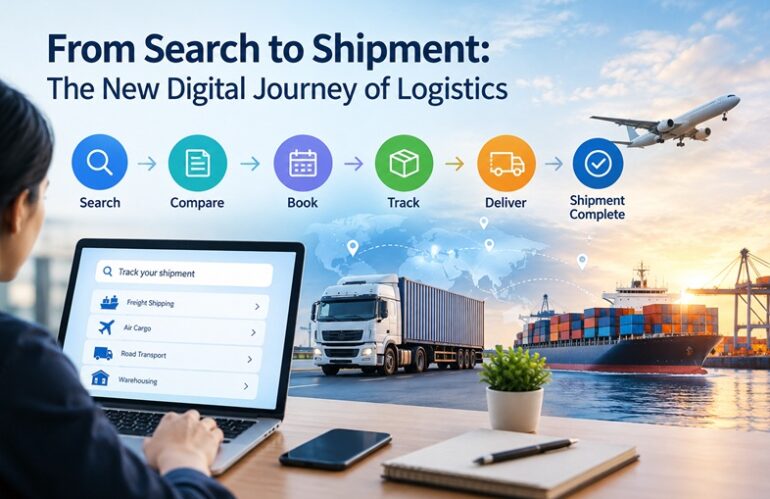
A potential customer may discover a logistics company through a search result, read an article, explore its service pages, compare capabilities and then submit an enquiry. The sales team may only enter the picture after several digital interactions have already taken place.
Traditional relationships remain important, but digital marketing can create another route into the sales process.
For an industry built around moving goods from one place to another, the customer journey itself is moving.
The journey can now begin with a search, continue through content and digital discovery, and eventually lead to a business conversation — and, ultimately, a shipment.
That is why digital marketing is becoming more than a visibility exercise for logistics companies. It is becoming another way to connect operational expertise with the businesses that need it.
For logistics companies looking to strengthen their digital presence, Shreyas Webmedia Solutions can help build a focused digital marketing strategy — from content and SEO to online visibility — helping businesses connect their logistics capabilities with the customers searching for them.