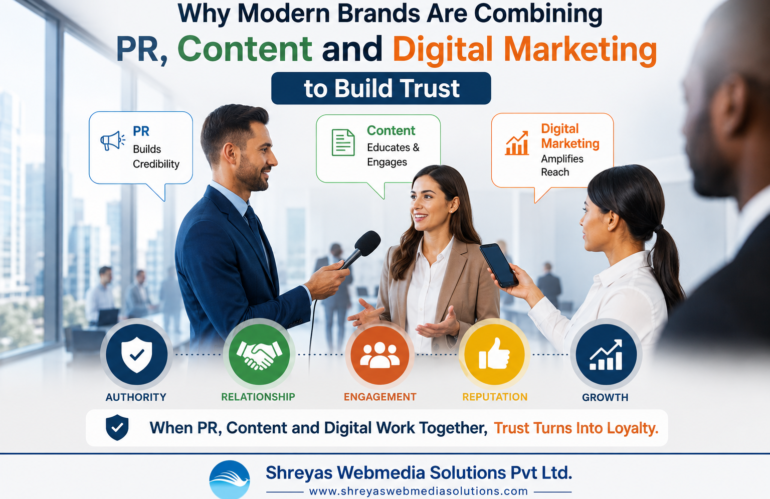
Aug 26: A brand can have a strong advertising budget and still struggle to earn consumer trust. In an environment where audiences encounter brands through search engines, social media, news websites, influencers and online reviews, visibility alone is no longer enough. Businesses increasingly need a coordinated strategy that combines public relations, content marketing and digital marketing to build credibility and maintain meaningful connections with their audiences.
The importance of trust is reflected in the 2025 Edelman Trust Barometer Special Report: Brand Trust, From We to Me. Based on research involving 15,000 respondents across 15 countries, the report found that 80% of respondents trust the brands they use. It also highlighted the importance of trusted information and credible voices in influencing perceptions of brands.
This is helping drive a shift from isolated marketing campaigns towards integrated brand communication.
Why PR, Content and Digital Marketing Are Converging
PR, content and digital marketing have traditionally operated as separate functions.
PR focused on media relations and reputation, content teams produced articles and other branded material, while digital marketing concentrated on search, social media, email and paid campaigns.
The customer journey, however, no longer follows these neat divisions.
A potential customer might discover a company through a social media post, encounter a media story about it, read an expert article on its website and then search for customer reviews before making a purchase.
Every interaction contributes to the brand’s overall image.
An integrated strategy ensures that these interactions communicate a consistent message.
PR Builds Credibility Beyond Advertising
Public relations remains an important part of modern brand strategy because it can put businesses and their executives into broader industry conversations.
Media coverage, interviews, expert commentary and thought leadership can help companies establish authority. PR can also give businesses an opportunity to explain their position on issues affecting their industry rather than communicating only through promotional advertising.
For newer companies, this can be particularly valuable. Strategic media visibility can introduce a brand to audiences that may not yet be familiar with its products or services.
Modern PR has also expanded beyond traditional newspapers and television. Digital publications, podcasts, newsletters, professional networks and online communities have created additional channels through which brands can build visibility.
Content Turns Attention Into Expertise
PR can attract attention, but content gives a brand the opportunity to demonstrate what it knows.
Articles, research reports, case studies, videos, guides and newsletters allow businesses to address customer questions and provide useful information.
This is particularly important for companies operating in complex sectors such as financial services, technology, healthcare and professional services, where customers often need information before making a decision.
Content can also extend the value of PR.
A media interview can become a blog article. An industry report can become a series of social media posts. An executive’s comments can be developed into a thought-leadership article.
Instead of creating every communication activity from scratch, brands can build multiple assets around a central idea.
Digital Marketing Converts Visibility Into Measurable Outcomes
Digital marketing adds another critical element: measurement.
Search engine optimisation can help people discover brand content, while social media can extend its reach. Paid advertising can target specific audiences, and email marketing can keep potential customers engaged.
More importantly, digital channels provide businesses with data.
Companies can monitor traffic, engagement, leads and conversions to understand which messages and content formats are generating results.
This information can then influence PR and content decisions.
For example, if an article about a particular industry challenge attracts significant organic traffic and engagement, the business may have identified a subject around which it can develop further content and PR activity.
One Brand Story Can Power an Entire Campaign
The strongest benefit of integration is the ability to turn one strong idea into a wider communication campaign.
Consider a company launching a new sustainability initiative.
Its PR team could announce the initiative and approach relevant media outlets. The content team could publish an in-depth explanation of the programme. The leadership team could contribute an opinion article, while the digital marketing team could promote the content through search, social media and targeted campaigns.
The same story is therefore reaching audiences through several channels without losing its central message.
This approach can make marketing investment more efficient while creating multiple opportunities for audience engagement.
Breaking Down Marketing Silos
Integration also addresses one of the biggest challenges facing modern marketing teams: working in silos.
HubSpot’s 2025 State of Marketing Report highlights continuing challenges around disconnected data, tools and organisational silos among marketing teams.
When PR, content and digital marketing teams work independently, valuable opportunities can be missed.
A PR team may secure an important media opportunity without having a content strategy ready to extend its impact. A content team may create an excellent article without sufficient distribution. A digital team may generate traffic without having strong content or brand messaging to support conversion.
Integration connects these activities.
Brand Consistency Builds Recognition
Consumers can encounter a company several times before deciding to engage with it.
A person might first see the brand on Instagram, later read a news article about it and eventually visit its website after searching for more information.
These interactions need to feel connected.
The message does not have to be identical across every platform. Instead, the brand’s positioning, values and tone should remain consistent.
This becomes particularly important as consumers increasingly expect brands to communicate with authenticity.
The Edelman report found that 73% of respondents said their trust in a brand would increase if it authentically reflected today’s culture.
For businesses, that makes authenticity more than a communication preference. It can become part of the wider brand strategy.
AI Is Accelerating Integrated Marketing
Artificial intelligence is further changing how marketing teams create and distribute content.
AI tools can help with research, content ideation, audience analysis, personalisation and campaign optimisation. They can also make it easier to adapt a single piece of content into different formats.
For example, a research report could be transformed into an article, a social media series, an email newsletter and talking points for an executive interview.
However, AI should support rather than replace the strategic thinking behind communication.
Original insights, human expertise and credibility remain essential to building a brand that audiences trust.
What Businesses Can Do
Companies looking to bring PR, content and digital marketing together can start with a few practical steps:
- Develop one central brand narrative that can be adapted across different channels.
- Plan PR and content together rather than treating media coverage as a standalone activity.
- Repurpose high-value content across social media, email, websites and other digital channels.
- Use digital data to guide future campaigns and identify subjects that resonate with audiences.
- Keep messaging consistent while adapting content to suit different platforms.
- Prioritise expertise and authenticity, particularly when using AI to create or distribute content.
From Marketing Channels to a Brand Ecosystem
The future of brand building is increasingly moving away from individual campaigns and towards connected ecosystems.
PR can generate credibility and third-party visibility. Content can demonstrate expertise and provide value. Digital marketing can expand reach, target audiences and measure performance.
When these functions work together, the result is more than increased exposure. It creates multiple opportunities for audiences to discover, understand and trust a brand.
For modern businesses, the objective is therefore not simply to generate publicity or drive digital traffic. It is to connect PR, content and digital marketing in a way that turns visibility into credibility, credibility into engagement and engagement into long-term brand value.