Aug 20: Businesses are entering a new phase of automation in 2026. Traditional automation remains widely used for repetitive, predictable processes, but AI agents are changing how companies approach more complex workflows that require interpretation, decision-making and coordination.
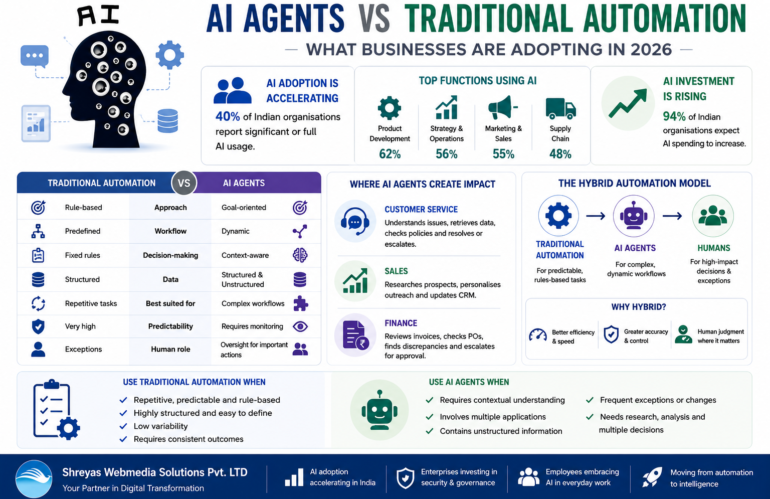
The shift is visible in enterprise adoption data. Deloitte’s 2026 India insights report that 40% of Indian respondents now report significant or full AI usage, compared with approximately 28% globally. At-scale AI deployment is strongest in product development, strategy and operations, marketing and sales, and supply chain functions.
At the same time, businesses are exploring agentic AI as the next stage of automation.
The important point, however, is that companies are not necessarily replacing traditional automation with AI agents. Instead, many are moving toward a hybrid model in which each technology is used for the type of work it handles best.
What Is Traditional Automation?
Traditional automation uses predefined rules and workflows to complete specific tasks.
Robotic process automation (RPA), workflow management systems and rule-based software are examples of this approach.
A business can use traditional automation to:
- Process standard invoices
- Send scheduled emails
- Update customer records
- Generate routine reports
- Route support tickets
- Transfer information between applications
- Trigger notifications based on predefined conditions
Its biggest advantage is predictability.
When a process has clear inputs, rules and outputs, traditional automation can complete it consistently without requiring sophisticated decision-making.
For businesses, this makes traditional automation particularly useful for repetitive, structured and high-volume processes.
What Are AI Agents?
AI agents represent a different approach.
Instead of simply following a fixed sequence of instructions, an AI agent can be given an objective and determine the steps needed to achieve it. Depending on how it is designed and governed, it can interpret information, use business applications, retrieve data and take actions.
For example, a customer-service AI agent could receive a complicated customer request, understand the issue, retrieve account information, review company policies and determine whether the matter can be resolved automatically or should be escalated to an employee.
This makes AI agents particularly relevant for multi-step and variable workflows.
Deloitte’s research on Indian organisations found that more than 80% of businesses were exploring autonomous agents in its 2025 India study, while 70% indicated a strong desire to use GenAI for automation.
The trend has continued into 2026 as enterprises move from AI experimentation toward broader operational deployment.
AI Agents vs Traditional Automation: Key Difference
| Feature | Traditional Automation | AI Agents |
|---|---|---|
| Approach | Rule-based | Goal-oriented |
| Workflow | Predefined | Dynamic |
| Decision-making | Fixed rules | Context-aware |
| Data | Mostly structured | Structured and unstructured |
| Flexibility | Limited | Higher |
| Best suited for | Repetitive tasks | Complex workflows |
| Predictability | Very high | Requires monitoring |
| Human involvement | Mainly exceptions | Oversight for important actions |
In simple terms, traditional automation tells software exactly what to do, while AI agents can determine what needs to be done within defined boundaries.
That distinction is becoming increasingly important for enterprises.
Why Businesses Are Moving Beyond Traditional Automation
Traditional automation has delivered efficiency for decades. But modern businesses increasingly deal with information that does not fit neatly into predefined rules.
Emails, contracts, customer conversations, documents, research reports and support requests contain unstructured information.
A conventional automation system can process such information only when the relevant rules and data structures have already been defined.
AI systems can interpret this information and potentially connect it with other business systems.
This creates an opportunity to automate processes that were previously considered too complex for conventional automation.
Example: Customer Service
Traditional automation can automatically route a customer complaint to the right department.
An AI agent could potentially read the complaint, identify the customer’s problem, retrieve relevant account information, check company policies, suggest a solution and initiate the next step.
Example: Sales
Traditional automation can send scheduled follow-up emails.
An AI agent could research a prospect, analyse previous interactions, prepare a personalised communication and update the CRM after the interaction.
Example: Finance
Traditional automation can process standard invoices.
An AI agent could investigate an unusual invoice, compare it with purchase orders and previous transactions, identify discrepancies and send the case to a finance professional for approval.
Businesses Are Increasingly Adopting a Hybrid Model
The biggest misconception surrounding AI agents is that they will immediately replace traditional automation.
In reality, businesses have strong reasons to keep both.
Traditional automation remains highly effective for processes where rules are stable and outcomes need to be predictable.
AI agents are more useful when workflows involve ambiguity, multiple systems or changing circumstances.
A business could therefore use:
Traditional automation → for predictable tasks
AI agents → for complex and dynamic tasks
Humans → for high-impact decisions and exceptions
This creates a hybrid automation model.
Rather than rebuilding every workflow around AI, companies can introduce agents selectively where they can create additional value.
Reports Show AI Adoption Is Accelerating in India
India is emerging as an important market for enterprise AI adoption.
According to Deloitte’s 2026 India report, 40% of Indian organisations surveyed reported significant or full AI usage, compared with around 28% globally. The report also found that 94% of Indian organisations expect AI spending to increase over the next year.
At-scale deployment is already visible across several business functions.
Product development leads at 62%, followed by strategy and operations at 56%, marketing and sales at 55%, and supply chain at 48%.
This indicates that Indian companies are increasingly treating AI as an operational capability rather than simply a technology experiment.
The report also identifies security and compliance controls, data management and scalable infrastructure among the major priorities required to support AI deployment.
AI Agents Could Change How Workflows Are Designed
The impact of AI agents may extend beyond automating individual tasks.
Traditional automation generally focuses on individual steps within an established process.
AI agents could enable businesses to automate a larger business objective.
Consider employee onboarding.
A traditional workflow could automatically create an email account after HR enters an employee’s information.
An AI-enabled workflow could potentially coordinate several tasks: review the employee’s role, determine which systems they need access to, prepare onboarding material, initiate account requests and notify relevant teams.
This represents a broader transition from task automation to outcome-oriented automation.
But AI Agents Come With New Challenges
Greater flexibility also means greater risk.
An automated rule-based system generally performs the same action when the same conditions occur.
An AI agent may interpret information differently depending on context. That makes testing, monitoring and governance critical.
Deloitte’s 2026 India report identifies regulatory and compliance requirements as the top AI integration challenge, cited by 39% of respondents, followed by resistance to change at 34%.
Indian businesses are therefore investing not only in AI technology but also in security, compliance, infrastructure and employee capabilities.
The report says 68% of Indian organisations identify security and compliance controls as a leading AI-enablement investment priority, while 61% cite data storage and management.
AI Agents Will Not Eliminate the Need for Humans
Another important change is the evolution of the human role.
AI agents may automate portions of knowledge work, but businesses still need employees to establish objectives, review important decisions, manage exceptions and oversee AI systems.
This is especially important for finance, healthcare, legal, cybersecurity and other areas where errors can have significant consequences.
Deloitte’s 2026 research on India’s workforce also shows that employees are becoming increasingly comfortable with AI. Ninety-three percent of Gen Z respondents and 95% of millennials in India reported using AI in their day-to-day work, while more than 90% of both groups said AI has had a positive impact on their professional and personal lives.
This suggests that the future workplace may increasingly involve employees working with AI rather than simply being replaced by automation.
Which Businesses Should Use Traditional Automation?
Traditional automation remains the better choice when a process is:
- Repetitive
- Predictable
- Rule-based
- Highly structured
- Easy to define
- Low in variability
- Required to produce consistent outcomes
For these workflows, adding an AI agent may create unnecessary complexity.
A simple rule-based workflow can often be cheaper, easier to audit and easier to control.
When Should Businesses Consider AI Agents?
AI agents become more attractive when a workflow:
- Requires contextual understanding
- Involves multiple applications
- Contains unstructured information
- Has frequent exceptions
- Requires research or analysis
- Changes depending on circumstances
- Requires several decisions before completion
Businesses should therefore evaluate the process first and the technology second.
The goal should not be to introduce an AI agent everywhere.
The goal should be to determine where an AI agent can produce a measurable improvement in productivity, customer experience, speed or decision-making.
The Business Case Is Moving From Automation to Intelligence
Traditional automation helped businesses answer one question:
“How can we perform this task faster?”
AI agents introduce a broader question:
“How can we complete this business objective with less manual coordination?”
That difference could have a significant impact on enterprise operating models.
Companies may increasingly redesign workflows around AI capabilities rather than simply adding AI tools to existing processes.
Deloitte’s 2026 India research similarly points to a shift from experimentation toward embedding AI into business operations, while highlighting the need for stronger governance, skills and organisational readiness.
What Businesses Are Likely to Adopt in 2026
The evidence points toward three layers of enterprise automation.
Traditional automation will continue handling predictable, rules-based work.
Generative AI will support employees with content, research, analysis and knowledge retrieval.
AI agents will increasingly be used for complex, multi-step workflows where software needs to interpret information and take actions.
The result is unlikely to be a simple replacement of one technology by another.
Instead, businesses are likely to build AI-powered automation stacks combining conventional automation, AI agents and human oversight.
Conclusion
The debate over AI agents vs traditional automation is evolving in 2026.
Traditional automation is not disappearing. It remains highly effective for repetitive and predictable processes where reliability and control matter most.
AI agents, meanwhile, are opening up a new category of automation for complex workflows that require interpretation, coordination and contextual decision-making.
For Indian businesses, the opportunity is particularly significant. Deloitte’s 2026 research shows that AI adoption in India is already ahead of the global average, with companies increasing investment and deploying AI across product development, operations, marketing, sales and supply chain functions.
The most effective strategy may therefore not be choosing AI agents or traditional automation, but knowing where each technology fits.
In 2026, the businesses gaining an advantage from automation may be those that combine the predictability of traditional automation, the flexibility of AI agents and the judgment of human employees.