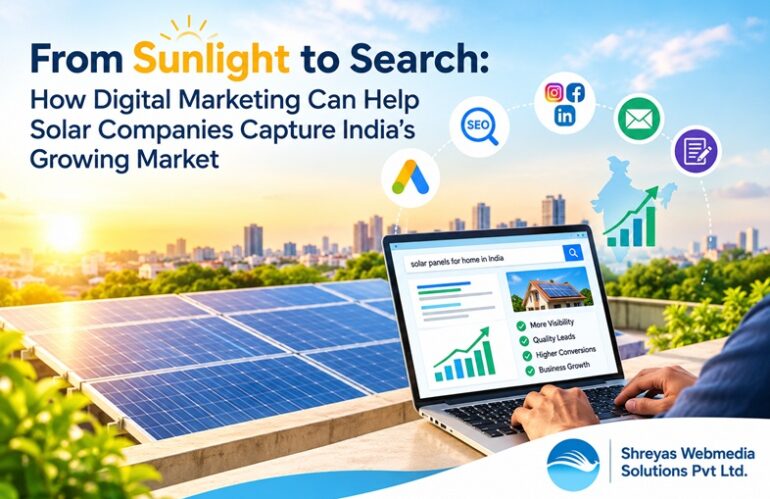
Sept 07: India’s solar industry is entering a new phase. Solar panels are no longer limited to large utility projects or a small group of environmentally conscious consumers. From residential rooftops and commercial buildings to large-scale industrial projects, solar energy is becoming a more familiar part of India’s energy landscape.
That growth is also making the market more competitive. For solar companies, having a good product or competitive pricing is no longer enough. Customers increasingly research companies, compare solutions, check reviews and look for information online before making contact.
This is where digital marketing for solar companies can make a real difference.
India’s Solar Market Is Getting Bigger
India’s solar capacity has grown significantly in recent years. According to the Ministry of New and Renewable Energy (MNRE), the country’s cumulative installed solar capacity reached 164.59 GW as of July 31, 2026. This included around 30.74 GW of grid-connected rooftop solar capacity.
The International Energy Agency (IEA) also reported that India’s annual renewable capacity additions increased by almost 60% in 2025, driven largely by the addition of nearly 50 GW of solar PV capacity.
The opportunity is clearly expanding, but so is the number of companies competing for customers.
For solar businesses, the challenge is increasingly about being discovered by the right audience and giving potential customers enough confidence to take the next step.
The Solar Customer Journey Often Starts Online
A homeowner considering rooftop solar may begin with a simple Google search: How much does a 5kW solar system cost?
A business owner might search for commercial solar installers near me. An industrial company could be researching industrial rooftop solar solutions or solar EPC companies in India.
These searches represent potential customers at different stages of the buying journey.
A strong digital presence allows solar companies to appear during these early research stages instead of waiting for customers to already know their brand.
SEO Can Help Solar Companies Get Found
Search engine optimisation remains one of the most useful digital marketing tools for solar businesses.
A solar company can create useful pages and articles around questions customers are already searching for, such as:
- Cost of rooftop solar installation
- Solar panel installation for homes
- Commercial solar solutions
- Solar subsidy and government schemes
- Solar system maintenance
- Solar panels for factories
- How much electricity a solar system can generate
- Solar ROI and payback period
Local SEO is equally important. Customers looking for installers generally want companies that can actually serve their location. Optimising Google Business Profiles, location pages and local search content can therefore help solar companies attract more relevant enquiries.
Content Marketing Can Answer Customer Questions
Solar is a technical industry, and many potential customers don’t fully understand the technology or the financial implications before they begin their research.
This creates an opportunity for companies to use content to explain rather than simply sell.
Articles, guides, videos and infographics can cover topics such as solar installation costs, maintenance, financing, energy savings, government incentives and the differences between various solar technologies.
For example, instead of publishing another generic post about the benefits of solar energy, a company could publish a practical guide explaining how much a 10kW rooftop solar system could potentially save a commercial property over time.
Useful content has a better chance of attracting people who are genuinely considering an investment.
Real Projects Can Build Trust
For solar companies, completed projects are valuable marketing assets.
Photographs, project details, customer experiences and measurable results can help potential buyers understand what the company is capable of delivering.
A case study showing how a manufacturing unit reduced its dependence on grid electricity, for example, can be far more convincing than a generic promotional statement.
Companies can showcase:
- Before-and-after project information
- Installation photographs
- Customer testimonials
- Energy-generation figures
- Project size and location
- Industries served
- Challenges solved during installation
This type of content can strengthen both search visibility and customer confidence.
Social Media Can Put Solar Projects in Front of New Audiences
Solar companies can also use platforms such as Instagram, Facebook, LinkedIn and YouTube to showcase their work.
Short videos can take viewers through an installation. A carousel can explain how rooftop solar works. A LinkedIn post can discuss a company’s latest commercial project or an industry development.
The goal should not be to post simply for the sake of maintaining a social media presence.
The content should give people a reason to stop, learn something or explore the company further.
Paid Search Can Capture High-Intent Customers
Organic search takes time. Paid advertising can help companies reach potential customers more quickly.
Google Ads, for example, can be used to target searches with strong commercial intent, such as:
- Solar companies near me
- Rooftop solar installation
- Commercial solar installers
- Solar EPC companies
- Industrial solar solutions
The important part is making sure the advertisement leads to a relevant landing page with clear information and a simple enquiry process.
Paying for clicks is not enough. The website needs to convert those clicks into genuine enquiries.
Your Website Is Your Digital Sales Desk
A solar company’s website often becomes one of the first places a potential customer visits after discovering the brand.
It should therefore make important information easy to find.
A well-structured website should clearly communicate:
- What the company offers
- Residential and commercial solutions
- Areas served
- Project experience
- Certifications and expertise
- Customer testimonials
- Contact information
- Enquiry options
A complicated website can make customers leave before they ever contact the sales team.
LinkedIn Can Help Solar Companies Reach B2B Buyers
For companies working in commercial, industrial, EPC or large-scale solar projects, LinkedIn can be particularly useful.
It provides an opportunity to reach business owners, facility managers, procurement teams, sustainability professionals, investors and industry partners.
Instead of using LinkedIn only for company announcements, solar businesses can share project insights, market developments, technical expertise and industry commentary.
This can help position the company as a knowledgeable participant in the renewable energy sector.
Lead Nurturing Matters Too
Not every person who visits a solar website is ready to buy immediately.
Some may be comparing suppliers. Others may still be calculating costs or waiting for approval from management.
This is where follow-up becomes important.
Email campaigns, WhatsApp communication, useful content and timely sales follow-ups can keep the company connected with potential customers until they are ready to make a decision.
The objective is simple: don’t lose a potentially valuable lead just because the customer wasn’t ready to buy on the first visit.
Measure Leads, Not Just Likes
A digital marketing campaign should ultimately contribute to business growth.
Solar companies should track metrics such as:
- Website enquiries
- Qualified leads
- Cost per lead
- Search rankings
- Organic traffic
- Conversion rates
- Calls and enquiry-form submissions
- Leads generated from specific campaigns
A post receiving thousands of views may look impressive, but a smaller campaign that generates qualified project enquiries could be far more valuable.
The Opportunity Is Growing — So Is the Competition
India’s expanding solar market presents a significant opportunity for businesses across residential, commercial and industrial segments.
But as more companies enter the market, simply having an online presence will not be enough.
Solar companies need to make sure that when customers search for solutions, the company appears with useful information, credible project experience and a clear way to get in touch.
That is where a focused solar marketing strategy can make a difference.
The Future of Solar Marketing Is About Being Found
India’s solar story is no longer only about installing more panels and generating more clean energy. It is also about how companies compete for customers in a rapidly expanding market.
Digital marketing can help solar businesses connect the two.
SEO can bring them into search results. Content can answer customer questions. Social media can showcase their work. Paid campaigns can capture high-intent searches. And strong follow-up can turn enquiries into business.
The solar industry may be powered by sunlight, but winning customers increasingly requires visibility.
The next solar customer may be looking at the sky — but their search for a solar company could start on Google.
With the right digital strategy, Shreyas Webmedia Solutions can help solar companies strengthen their online visibility, build industry credibility and reach the audiences that matter to their growth.