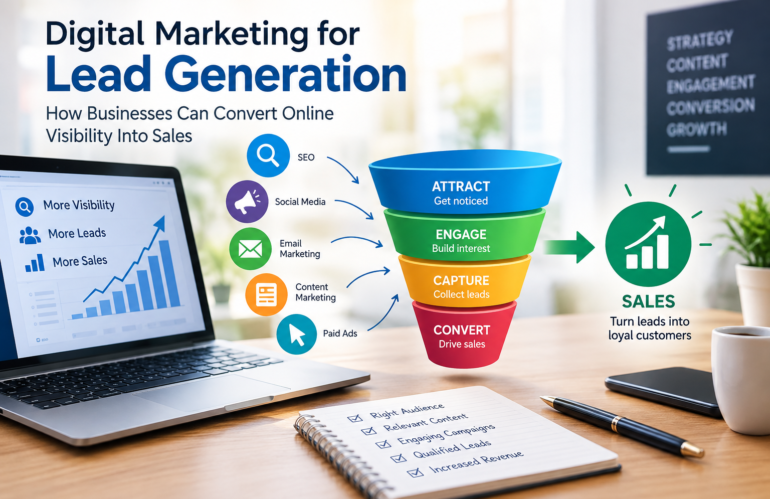
Oct 16: Businesses can rank well on Google, attract website visitors and remain active on social media without generating enough enquiries to support growth. For many companies, the challenge is no longer just getting noticed online. It is turning that attention into genuine business opportunities.
Online visibility is an important starting point, but it does not guarantee sales. Businesses need to reach the right audience, understand what potential customers are looking for and make it easy for them to take the next step.
For startups, small businesses and established companies, effective digital marketing means attracting relevant prospects and measuring how successfully those prospects become customers.
Why Website Traffic Does Not Always Generate Qualified Leads
A rise in website traffic may look encouraging, but not every visitor intends to buy a product or hire a service. Some people are looking for general information, while others are comparing providers or preparing to make a purchase.
Consider an accounting firm that attracts visitors searching for basic accounting definitions. These readers may help build brand awareness, but they may not be ready to hire an accountant. Articles about tax compliance for small businesses, accounting requirements and choosing a professional service provider could attract fewer visitors while generating more relevant enquiries.
The difference lies in understanding customer intent. Businesses need to assess not only how many people visit their websites, but also what those visitors want and whether the content encourages them to take action.
Create Content Around Customer Intent
Search engine optimisation becomes more effective when content answers the questions potential customers ask at different stages of their decision-making process.
People who are beginning to explore a problem may benefit from educational articles, introductory guides and explanatory videos. Those comparing solutions may look for detailed service pages, comparisons, practical examples and case studies.
Customers ready to make a purchase generally need clear service descriptions, relevant credentials, pricing information where appropriate and a straightforward way to contact the business.
A balanced content strategy addresses all three stages. Informational articles introduce the business to potential customers, while detailed service pages help interested visitors evaluate the available options.
Build Trust Before Asking Customers to Take Action
Search rankings alone rarely determine whether a customer chooses a business. Potential customers may also check online reviews, company credentials, previous work and contact information before making an enquiry.
Businesses can build confidence by providing accurate information, explaining their services clearly and responding professionally to customer feedback. Genuine testimonials and case studies can demonstrate experience when used with appropriate permission.
Trust is especially important in healthcare, finance, education and professional services, where customers may need to evaluate qualifications, costs and potential risks before making a decision.
Consistency matters, too. If an advertisement promotes a particular service, the landing page should deliver the information customers expect. Unclear pricing, exaggerated promises and unexpected conditions can discourage enquiries even when a campaign attracts the right audience.
Optimise Landing Pages to Improve Conversions
A landing page should help visitors understand an offer and decide what to do next.
For example, a digital agency promoting website development for small businesses could create a dedicated page explaining its services, project timelines, pricing approach and consultation process. Instead of sending every visitor to a generic homepage, the agency can direct interested prospects to information that addresses their specific needs.
Website performance also affects the customer experience. Slow-loading pages, poor mobile usability and complicated enquiry forms can cause visitors to leave before completing an action.
Businesses can test different headlines, calls to action and page layouts to identify which approaches work best. The goal is to make the next step clear without overwhelming visitors with unnecessary information.
What Marketing Research Reveals About Conversion Goals
HubSpot’s 2026 State of Marketing research highlights the growing importance of connecting marketing activity with measurable business outcomes. In its published findings, 28% of surveyed marketers identified increasing conversion rates as a primary objective for 2026. The research also examines how marketers are using AI, building brand trust and improving marketing performance.
The finding illustrates why businesses need to evaluate what happens after a potential customer discovers their brand. Website traffic and social media engagement can indicate audience interest, but businesses also need to know whether that interest leads to enquiries, sales and revenue.
Google Analytics provides practical tools for measuring the customer journey. Its official lead-generation guidance explains how businesses can track website visits, form views, form starts and submissions to identify where potential customers leave the process.
These resources offer a useful foundation for improving lead generation. However, campaign performance will vary according to the industry, target audience, competition, pricing and quality of the offer.
A Practical Example: Turning Website Visits Into Enquiries
Consider a small web development agency that receives 2,000 website visits in a month but generates only 10 enquiries. Its immediate response might be to invest more money in advertising to increase traffic.
A closer examination could reveal that the service pages do not explain project costs, the consultation button is difficult to find on mobile devices, or the enquiry form asks for too much information.
The agency could create a dedicated landing page for small businesses, clarify its services, simplify the form and add genuine client testimonials. It could then track form submissions and assess whether the enquiries match its target customers.
If these changes generate more relevant enquiries from the same volume of traffic, the agency may improve its marketing efficiency without immediately increasing its advertising budget.
This is an illustrative example, not a forecast of guaranteed results. Actual improvements depend on customer behaviour and the quality of the changes made.
Use AI and Automation to Manage Leads More Effectively
AI-powered marketing tools and customer relationship management systems can help businesses organise enquiries, identify recurring customer questions and monitor potential sales.
For instance, an automated system can categorise incoming enquiries by service requirement, assign them to the appropriate team and send an acknowledgement after a form is submitted. A CRM platform can also record whether prospects progress to consultations, proposals and completed sales.
Over time, businesses can compare marketing channels and identify which ones attract the most relevant prospects.
However, automation cannot replace good customer service. Enquiries still require timely responses, accurate information and meaningful communication. Businesses must also protect customer data and ensure that automated messages accurately represent their services.
The most effective approach combines technology with human judgement, particularly when evaluating complex enquiries or high-value sales opportunities.
Measure Lead Quality, Conversion Rates and Customer Acquisition Costs
Businesses should look beyond impressions, followers and website visits when evaluating digital marketing performance. These figures indicate reach, but they do not necessarily show whether marketing activity contributes to revenue.
Several metrics can provide a clearer picture:
- Lead conversion rate: The percentage of visitors who complete a desired action, such as submitting an enquiry.
- Cost per lead: The marketing expenditure required to generate a lead.
- Qualified lead rate: The proportion of enquiries that match the business’s target customer profile.
- Lead-to-customer conversion rate: The percentage of leads that eventually become paying customers.
- Customer acquisition cost: The relevant sales and marketing costs associated with acquiring a customer.
These metrics should be assessed together. A campaign that generates hundreds of enquiries may deliver limited value if most prospects are unsuitable or unlikely to purchase.
By contrast, a campaign attracting fewer but better-qualified leads may produce stronger commercial results. Businesses should also consider the revenue generated, the time required to convert prospects and the resources needed to serve new customers.
Build a Digital Marketing Strategy That Supports Business Growth
Businesses do not necessarily need expensive marketing platforms to improve lead generation. A well-organised website, useful content, clear service information and a straightforward enquiry process can provide a strong foundation.
The next step is to define what qualifies as a good lead and ensure that marketing and sales teams use consistent criteria. Regular reviews can reveal which pages attract relevant visitors, which campaigns generate enquiries and where potential customers drop out of the process.
As a business grows, CRM platforms, analytics tools and automation can help manage enquiries and assess performance across multiple channels.
The priority should be to use these tools to solve specific business problems rather than adopting technology simply because it is available.
Conclusion
Digital marketing for lead generation requires more than strong search rankings or an active social media presence. Businesses need to understand customer intent, publish relevant content, build trust and create straightforward paths from discovery to enquiry.
Industry research and analytics tools can help companies measure progress, while AI and automation can improve the way leads are managed. Ultimately, results depend on reaching the right audience, offering relevant solutions and delivering a positive customer experience.
For businesses seeking sustainable growth, the objective is clear: turn online visibility into meaningful enquiries, valuable customer relationships and measurable revenue.