
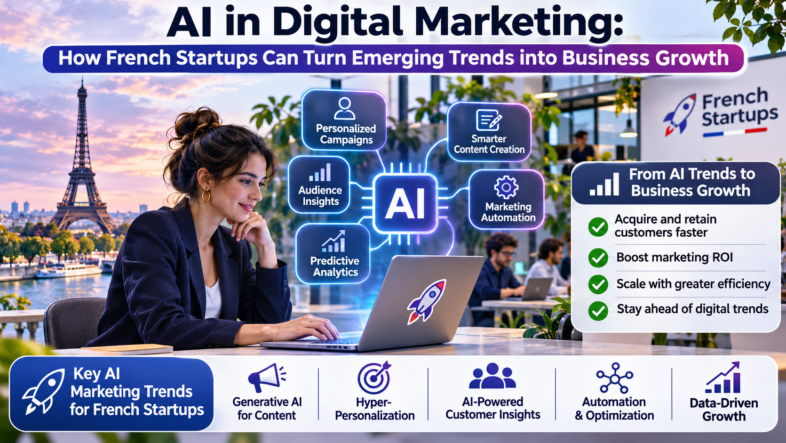
Nov 20: Artificial intelligence is changing how businesses approach digital marketing. From understanding customer behaviour to creating content and managing advertising campaigns, AI is helping companies make faster, data-driven decisions.
For startups in France, this shift presents an opportunity to compete with established brands without necessarily building large marketing teams. AI-powered tools can help smaller businesses automate routine activities, identify potential customers and develop more relevant campaigns.
However, adopting AI is not simply about using new software. Startups need to understand where the technology can make a measurable difference, how to use customer data responsibly and how to maintain the creativity and human connection that make marketing effective.
As AI adoption grows across French businesses, startups that combine technology with a clear marketing strategy could gain an advantage in an increasingly competitive digital marketplace.
AI Adoption in France: What the Latest Industry Data Reveals
The growing use of AI in French businesses provides an important backdrop to the changing digital marketing landscape.
According to the French government’s France Num 2026 Barometer, published in September 2026, 39% of very small businesses and small and medium-sized enterprises (SMEs) reported using AI solutions for professional purposes. This was three times the 2024 level. Adoption was higher among SMEs, at 53%, compared with 37% among very small businesses.
The findings indicate that AI is moving beyond experimentation and becoming part of everyday business operations. For startups, this creates an opportunity to explore applications such as customer communication, content production, marketing automation and data analysis.
A separate study by France’s National Institute of Statistics and Economic Studies (INSEE), published in July 2026, found that 18% of businesses with at least 10 employees in France used at least one AI technology in 2025, compared with 10% in 2024. Adoption reached 59% in the information and communication sector.
The two studies cover different business populations and use different survey definitions, but both point towards growing AI adoption in France. They also highlight the need for businesses to develop the skills required to use these technologies effectively.
How AI Is Changing the Digital Marketing Landscape
Traditional digital marketing involves collecting customer information, developing campaigns and measuring performance across multiple platforms. AI is making many of these activities faster and more connected.
By analysing large volumes of information, AI tools can identify patterns, predict customer preferences and help marketers adjust campaigns based on performance.
For startups, some of the most important applications include:
-
Personalised marketing: AI helps businesses understand customer interests and deliver more relevant messages, recommendations and offers.
-
Predictive analytics: Machine learning can identify patterns in customer behaviour and help marketers anticipate potential buying decisions.
-
Marketing automation: Repetitive activities such as email scheduling, audience segmentation and campaign reporting can be streamlined.
-
Content development: Generative AI can assist with creating drafts, social media content, advertising variations and campaign ideas.
-
Advertising optimisation: AI-powered advertising platforms can help identify audiences, adjust bids and improve campaign delivery.
These capabilities can help smaller businesses use their marketing budgets more strategically while reducing the time spent on repetitive work.
Key AI Trends French Startups Should Watch
1. Conversational Marketing Through AI Chatbots
Customers increasingly expect businesses to respond quickly, whether they are browsing a website, comparing products or seeking after-sales assistance.
AI chatbots can help startups manage these interactions without requiring a large customer support team. They can answer frequently asked questions, guide visitors towards relevant products and collect basic enquiries.
For businesses operating in France and targeting international customers, multilingual support is particularly useful. Chatbots can be configured to communicate in French and other languages, helping brands serve different customer groups.
For example, a French travel startup could use a chatbot to answer questions about destinations, accommodation and booking procedures. A software startup could use one to guide website visitors towards suitable products or demonstration requests.
However, customers should have the option to reach a human representative when an enquiry requires personal attention or a detailed response.
2. Voice Search and Conversational Search Optimisation
Search behaviour is moving beyond short keyword phrases. Customers increasingly use natural language when asking questions through voice assistants and AI-powered search tools.
This creates an opportunity for French startups to develop content that answers specific customer questions in clear, conversational language.
Businesses should consider:
-
Using natural French-language search phrases.
-
Creating informative pages that directly answer customer questions.
-
Improving website structure and technical SEO.
-
Providing accurate business information across digital platforms.
-
Developing useful content around customer needs and search intent.
Voice search should be treated as part of a wider search strategy rather than a separate marketing channel. Strong content, clear answers and a technically sound website remain important.
3. AI-Powered Content Creation
Content marketing helps startups build visibility, communicate expertise and attract potential customers. However, consistently producing quality content can be challenging when marketing teams are small.
Generative AI tools can support content development by suggesting topics, preparing outlines, creating first drafts and adapting messages for different platforms.
For example, a French technology startup could use AI to develop an initial blog outline, convert key ideas into social media posts and prepare different versions of an email campaign.
The real value comes from combining AI assistance with human editorial judgement. Businesses still need to verify facts, maintain their brand voice, understand cultural context and ensure that the final content offers something useful to readers.
4. Predictive Analytics for Better Customer Insights
Understanding what customers may do next can help startups make more informed marketing decisions.
AI-powered predictive analytics examines historical information, including website visits, previous purchases, customer interactions and campaign responses. It can identify patterns that may indicate purchase interest, customer churn or changing preferences.
An online retailer, for instance, could use customer behaviour data to identify shoppers who regularly purchase particular product categories. The business could then develop relevant recommendations or promotional campaigns.
These insights can help startups improve customer retention, plan marketing activities and allocate resources more effectively.
However, predictions are only as reliable as the data and assumptions behind them. Businesses should regularly evaluate model performance rather than treating AI-generated forecasts as guaranteed outcomes.
5. AI-Driven Programmatic Advertising
Digital advertising is becoming increasingly automated. AI-powered advertising platforms can analyse campaign performance and adjust bidding, audience selection and ad delivery.
For startups, this can make it easier to test different campaign approaches without manually managing every advertising decision.
Platforms such as Google Ads and Meta Ads incorporate machine learning into their advertising systems. These features can help businesses identify potential customers and optimise campaigns towards selected objectives.
Nevertheless, automation does not eliminate the need for a clear advertising strategy. Startups must define their target audiences, monitor spending, test creative content and assess whether campaigns are generating meaningful business results.
6. AI Tools for Visual and Video Marketing
Visual content has become an important part of digital communication. Businesses use images, short videos, product demonstrations and graphics to attract attention and explain their offerings.
AI-powered design and editing tools are making these activities more accessible to startups that may not have dedicated creative departments.
Tools such as Canva’s Magic Design and Adobe’s AI-powered creative features can assist with generating design ideas, adapting layouts and speeding up editing workflows.
Startups can use these capabilities to produce campaign graphics, product presentations and social media videos.
However, visual consistency, originality and brand identity remain essential. AI-generated content should be reviewed before publication, particularly when it includes product details, people or claims about a business.
7. Sentiment Analysis and Online Reputation Management
For a growing startup, customer feedback can influence brand perception and purchasing decisions.
AI-based sentiment analysis helps businesses examine online reviews, social media conversations and customer comments to understand how people respond to their products or services.
These insights can help marketing teams identify recurring complaints, assess campaign reactions and recognise emerging customer expectations.
Startups can use social listening and media monitoring tools to track brand mentions and identify conversations that require attention.
The technology should support, rather than replace, human interpretation. Sarcasm, cultural references and context can sometimes make automated sentiment analysis inaccurate.
How French Startups Can Use AI to Generate Leads and Retain Customers
AI can deliver practical value when it is connected to specific business objectives. Startups do not need to adopt every available technology at once. They can begin by identifying where potential customers are being lost or where marketing teams spend too much time on repetitive work.
Lead generation: AI can help analyse website interactions, identify high-interest visitors and prioritise enquiries for follow-up. Businesses can also use it to develop relevant landing-page content and test different campaign messages.
Customer retention: By examining purchase history and engagement patterns, AI tools can help identify customers who may be losing interest. Startups can use these insights to plan timely communication and relevant offers.
Email marketing: AI can assist with audience segmentation, subject-line testing and campaign timing. Businesses can tailor messages to customer interests rather than sending identical communications to every subscriber.
Customer support: Chatbots and automated response systems can handle routine enquiries, allowing employees to focus on complex customer needs.
Campaign measurement: AI-supported analytics can help marketers understand which channels contribute to enquiries, conversions and repeat purchases.
The objective should be to improve the quality of customer relationships, not simply increase the number of automated interactions.
How AI Can Improve the Customer Journey
A customer’s journey rarely takes place through a single interaction. Someone may discover a business through a search engine, visit its website, read customer reviews and return later through an email or social media advertisement.
AI can help startups connect information from these different touchpoints, where data is lawfully collected and appropriately managed.
By understanding customer interactions, businesses can identify where potential customers lose interest and which marketing activities contribute to conversions.
For example, a travel startup could use AI to understand which destinations attract the most website interest, identify frequently asked questions and provide relevant travel recommendations.
Similarly, a software company could analyse how visitors interact with its product pages and identify content that helps move potential customers towards a demonstration or subscription.
A better understanding of the customer journey allows startups to make their marketing more relevant and reduce unnecessary communication.
Industries in France That Can Benefit From AI-Driven Marketing
AI-powered marketing has applications across several sectors of the French economy.
E-commerce and retail: Businesses can use recommendation systems, customer segmentation and demand insights to improve online shopping experiences.
Travel and hospitality: Hotels, travel companies and tourism startups can use chatbots, personalised recommendations and automated communication to engage travellers.
Healthcare and wellness: Organisations can use AI to improve the relevance of educational content and customer communication, while maintaining safeguards around sensitive personal data and healthcare claims.
Financial services: Fintech startups can use customer insights to improve product communication and personalise marketing, subject to applicable financial and data protection requirements.
Entertainment and media: Streaming services and digital content businesses can use recommendation systems to help audiences discover relevant content.
These applications demonstrate that AI marketing is not restricted to technology companies. Businesses across different industries can use it to improve customer engagement and operational efficiency.
Challenges French Startups Must Consider
Although AI offers significant opportunities, its adoption also brings practical and regulatory challenges.
Data Privacy and GDPR Compliance
Customer data is central to many AI marketing applications. French startups must ensure that their data collection and processing practices comply with the European Union’s General Data Protection Regulation (GDPR) and applicable French requirements.
Businesses should pay attention to transparency, lawful processing, data minimisation, appropriate security measures and the rights of individuals.
Where AI tools process personal information, companies should also understand how third-party providers use, retain and protect that information.
Implementation Costs
Some advanced AI platforms can be expensive, particularly for startups operating with limited budgets.
A practical approach is to begin with tools that address specific business requirements, such as email automation, customer support or campaign analytics. Companies can expand their technology investments as measurable benefits emerge.
Skills and Human Oversight
AI tools still require people who understand marketing strategy, data interpretation and customer behaviour.
The INSEE 2026 study highlights the importance of expertise: more than half of businesses using AI reported that a lack of expertise limited their use of the technology.
Startups should therefore invest in training their teams to use AI responsibly and evaluate its output. Human oversight is particularly important when producing public-facing content, managing customer complaints or making decisions that could affect individuals.
Maintaining Authentic Brand Communication
Excessive automation can make marketing messages feel generic. Customers still value originality, trust and meaningful interactions.
Startups should use AI to support creativity and improve efficiency rather than allowing automated systems to determine every aspect of their brand communication.
A Practical AI Adoption Strategy for Startups
For early-stage businesses, the best approach is to start with a specific marketing challenge rather than investing in multiple AI platforms at the same time.
A practical adoption process can include:
-
Identify a business need: Determine whether the priority is lead generation, customer support, content production or campaign performance.
-
Choose a suitable tool: Select an AI solution that addresses that requirement and fits the available budget.
-
Start with a limited project: Test the technology on one campaign or workflow before expanding its use.
-
Measure the results: Track relevant indicators such as qualified leads, conversion rates, customer response times and campaign costs.
-
Review data and privacy practices: Check how customer information is collected, processed and stored.
-
Retain human oversight: Ensure that employees review AI-generated content, recommendations and customer-facing communication.
This approach allows startups to understand the practical value of AI before committing to larger technology investments.
The Road Ahead: What AI Means for Digital Marketing in France
AI is likely to become more deeply integrated into digital marketing as businesses adopt increasingly capable tools for content development, customer analysis, advertising and automation.
For French startups, the opportunity lies in using these technologies to compete more effectively without losing sight of their customers.
Future developments may include more advanced conversational assistants, AI-supported creative production, improved predictive modelling and greater integration of marketing data across platforms. Search experiences are also evolving, making useful, trustworthy and well-structured content increasingly important.
At the same time, privacy, transparency and responsible use of customer information will remain important considerations within the European regulatory environment.
Startups that combine technological capabilities with strong marketing fundamentals will be better positioned to adapt to these changes.
Conclusion
AI is changing how businesses approach digital marketing, offering French startups new ways to understand audiences, improve campaign performance and build stronger customer relationships.
From conversational chatbots and predictive analytics to automated advertising and AI-assisted content creation, these technologies can help smaller businesses operate more efficiently and compete in an increasingly crowded marketplace.
However, successful adoption requires more than investing in software. Startups need clear marketing objectives, reliable data, skilled professionals and appropriate privacy safeguards.
For businesses looking to strengthen their digital presence, experienced marketing support can help translate AI capabilities into practical strategies. Shreyas Webmedia Solutions can support businesses through digital marketing, content development and data-driven communication strategies. The focus should remain on combining technology with relevant content, audience understanding and measurable business outcomes.



Leave a Reply
You must be logged in to post a comment.