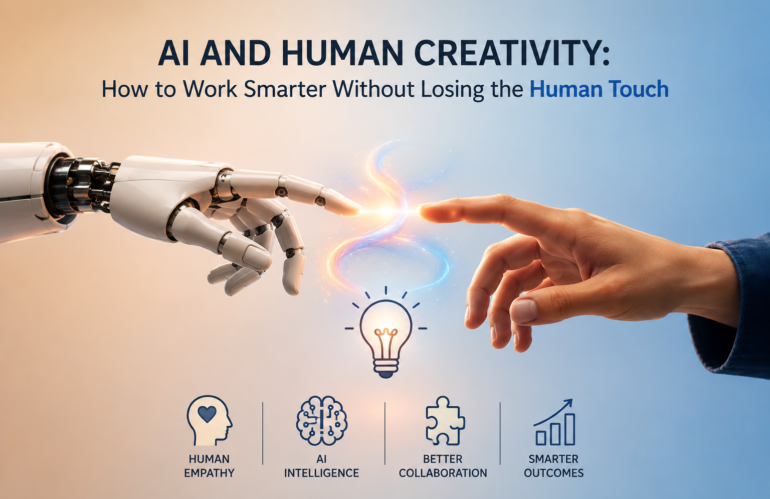
Aug 21: Artificial intelligence is changing the way people write, design, research, brainstorm and solve problems. AI tools can generate ideas in seconds, organise information and handle repetitive tasks. But as these tools become more powerful, one question is becoming increasingly important: How can we use AI without sacrificing human creativity?
The answer is not to avoid AI. Instead, AI can be treated as a creative assistant, while humans remain responsible for ideas, direction, judgment and the final result.
Creativity is more than producing something quickly. It involves experience, imagination, emotion, curiosity and the ability to look at a problem from a different perspective. These qualities remain important even as AI becomes more sophisticated.
AI Is Already Changing Creative Work
AI has rapidly become part of professional life. Microsoft’s and LinkedIn’s 2024 Work Trend Index, based on 31,000 people across 31 countries, found that 75% of knowledge workers were using AI at work. Many users reported that AI helped them save time and focus on more important work.
The research also found that AI was being used for creative tasks, suggesting that artificial intelligence is becoming part of the creative workflow rather than simply an automation tool.
For creators, the challenge is to make sure that convenience does not replace original thinking.
What Does Human Creativity Mean in the Age of AI?
Human creativity involves generating original ideas, making connections between different concepts, solving problems and communicating perspectives in meaningful ways.
AI can produce text, images, music and other content by identifying patterns in existing information. However, people provide the purpose and context.
For example, an AI tool can produce ten marketing campaign ideas. A human still needs to decide which idea suits the brand, understands its audience and has the potential to stand out.
AI can accelerate creative work, but humans should remain responsible for creative direction.
Use AI for Brainstorming, Not the Final Answer
One of the best ways to use AI without losing creativity is to treat it as a brainstorming partner.
Instead of asking AI to create an entire project, use it to:
- Generate alternative ideas
- Suggest different approaches
- Identify potential themes
- Challenge an existing concept
- Provide opposing viewpoints
- Explore unusual possibilities
- Help overcome writer’s block
The creator can then select, modify, combine or reject those suggestions.
This keeps humans involved in one of the most important parts of creativity: deciding which ideas deserve further development.
Start With Your Own Ideas
A simple way to protect creativity is to think before turning to AI.
Spend a few minutes developing your own concept, message or outline. Once you have a starting point, AI can help you explore and expand it.
For example, a writer can create the basic structure of an article independently and then ask AI for alternative headlines or additional angles.
This prevents AI from becoming the source of every creative decision.
Use AI to Explore, Not Imitate
AI can help creators experiment with different approaches, but using it to imitate a particular person’s distinctive creative style is not a substitute for developing an original voice.
Instead, experiment with broader directions such as:
- Conversational
- Minimalist
- Humorous
- Dramatic
- Informative
- Emotional
- Direct and concise
The creator can then decide which approach best fits the project.
Keep Human Experience at the Centre
Personal experience remains one of the strongest sources of originality.
AI can describe a destination, but a traveller’s own observations can make a story memorable. AI can suggest topics for an article, but a writer’s personal insights can give the article a distinctive perspective.
Experiences, emotions, cultural understanding and individual opinions can make content feel authentic.
Let AI assist with the process, but let humans provide the perspective.
Use AI for Repetitive Work
Not every part of creative work requires imagination.
AI can save time on tasks such as:
- Summarising research
- Organising information
- Creating initial outlines
- Generating variations
- Checking grammar
- Formatting content
- Analysing large amounts of information
- Preparing routine drafts
Microsoft and LinkedIn’s research found that many AI users reported significant time savings and said AI helped make their workloads more manageable.
The opportunity is to use that saved time for activities that require deeper thinking.
7 Practical Rules for Using AI Without Losing Creativity
Using AI effectively does not require giving up control of the creative process. These seven rules can help maintain the right balance.
1. Think First, Prompt Second
Develop your own initial idea before asking AI for suggestions. This ensures that your creative direction starts with you.
2. Use AI for Options, Not Decisions
Ask AI for alternatives, possibilities and different perspectives. Make the final decision yourself.
3. Add Your Own Experience and Insights
Personal observations, experiences and opinions can make AI-assisted work more distinctive and authentic.
4. Challenge the First AI Response
Don’t automatically accept the first answer. Ask what is missing, what could be improved and what assumptions the response makes.
5. Use AI for Repetitive Tasks
Delegate routine activities such as formatting, summarising and basic organisation to AI where appropriate.
6. Fact-Check Important Information
Verify statistics, names, dates, quotations and other important claims using reliable sources before publication.
7. Always Perform a Human Final Edit
The final version should reflect the creator’s voice, standards, purpose and judgment.
Don’t Accept the First AI Output
One of the easiest ways to make AI-assisted content sound generic is to use the first response without meaningful changes.
Treat AI output as raw material.
Ask yourself:
- Does this sound like me?
- Is the idea genuinely interesting?
- What is missing?
- What would I disagree with?
- Can I add a personal example?
- Can I make the argument more distinctive?
- Is the information accurate?
The process of questioning and improving AI output is where much of the human creative contribution happens.
Use AI to Challenge Your Thinking
AI can also be used to challenge ideas rather than simply generate them.
A writer might ask:
What are the weaknesses in this argument?
A business owner could ask:
What objections might customers have?
A designer could ask:
What assumptions does this concept make about its audience?
This approach can help creators identify blind spots and develop stronger ideas.
Maintain Your Own Creative Voice
One of the risks of excessive AI use is producing content that sounds similar to everything else generated by AI.
Creators should therefore continue developing their own voice.
Writers should maintain their vocabulary, storytelling techniques and perspectives. Designers should continue applying their own visual judgment. Marketers should continue understanding their audiences rather than relying entirely on automated suggestions.
AI should follow the creator’s direction — not the other way around.
Human Creativity Remains Important
The World Economic Forum’s Future of Jobs Report 2025 provides an important perspective. While it identifies AI and big data among the fastest-growing skills, the report also expects creative thinking, resilience, flexibility, agility, curiosity and lifelong learning to become increasingly important through 2030.
The message is clear: learning how to use AI is important, but human capabilities still matter.
For creative professionals, knowing how to operate an AI tool is only part of the equation. The ability to understand people, identify meaningful ideas and make good creative decisions remains essential.
Verify AI-Generated Information
AI can produce information that sounds convincing but is inaccurate or outdated.
This makes human verification particularly important for articles, reports, marketing materials and educational content.
Before publishing AI-assisted content:
- Check important claims against reliable sources
- Verify statistics
- Confirm dates and names
- Check quotations
- Review original reports
- Remove unsupported claims
AI can accelerate research, but the creator remains responsible for the accuracy of the final work.
Use AI as a Creative Multiplier
The strongest relationship between humans and AI does not have to be human versus machine.
It can be human plus machine.
A practical creative workflow could be:
Human idea → AI brainstorming → Human selection → AI assistance → Human editing → Human final judgment
For example, a writer might develop an article concept, ask AI for possible structures, conduct independent research, write the key sections, use AI to identify weaknesses and then perform the final edit.
AI saves time, but the human remains in control.
Create Before You Automate
Automation should follow understanding.
Before automating a creative process, identify which tasks are repetitive and which require human judgment.
A useful division is:
Human-led: Strategy, original ideas, personal experiences, ethical decisions and final judgment.
AI-assisted: Brainstorming, research organisation, editing and alternative ideas.
AI-automated: Routine formatting, basic summaries and repetitive processes.
This helps ensure that automation does not remove the most valuable part of creative work.
The Future of AI and Human Creativity
AI will become an increasingly common part of creative work. Writers, designers, marketers, filmmakers, entrepreneurs and other professionals are likely to use AI to explore ideas and speed up production.
But this could make human originality even more important.
When everyone can generate content quickly, distinctive ideas, authentic experiences and strong perspectives can become powerful differentiators.
The competitive advantage may therefore shift from simply being able to produce content to knowing what is worth creating and why.
Conclusion
The question is not whether people should use AI for creative work. The more important question is how to use AI without sacrificing human creativity.
Research from Microsoft and LinkedIn shows that AI is already widely used by knowledge workers, while the World Economic Forum expects creative thinking to remain an important skill even as AI and big data become increasingly valuable.
The most effective approach is to treat AI as a tool rather than a replacement for imagination.
Let AI handle repetitive work, generate alternatives, challenge assumptions and accelerate research. But keep humans responsible for vision, emotion, originality, judgment and the final creative decision.
AI can make the creative process faster. Human creativity is what can make the result meaningful.